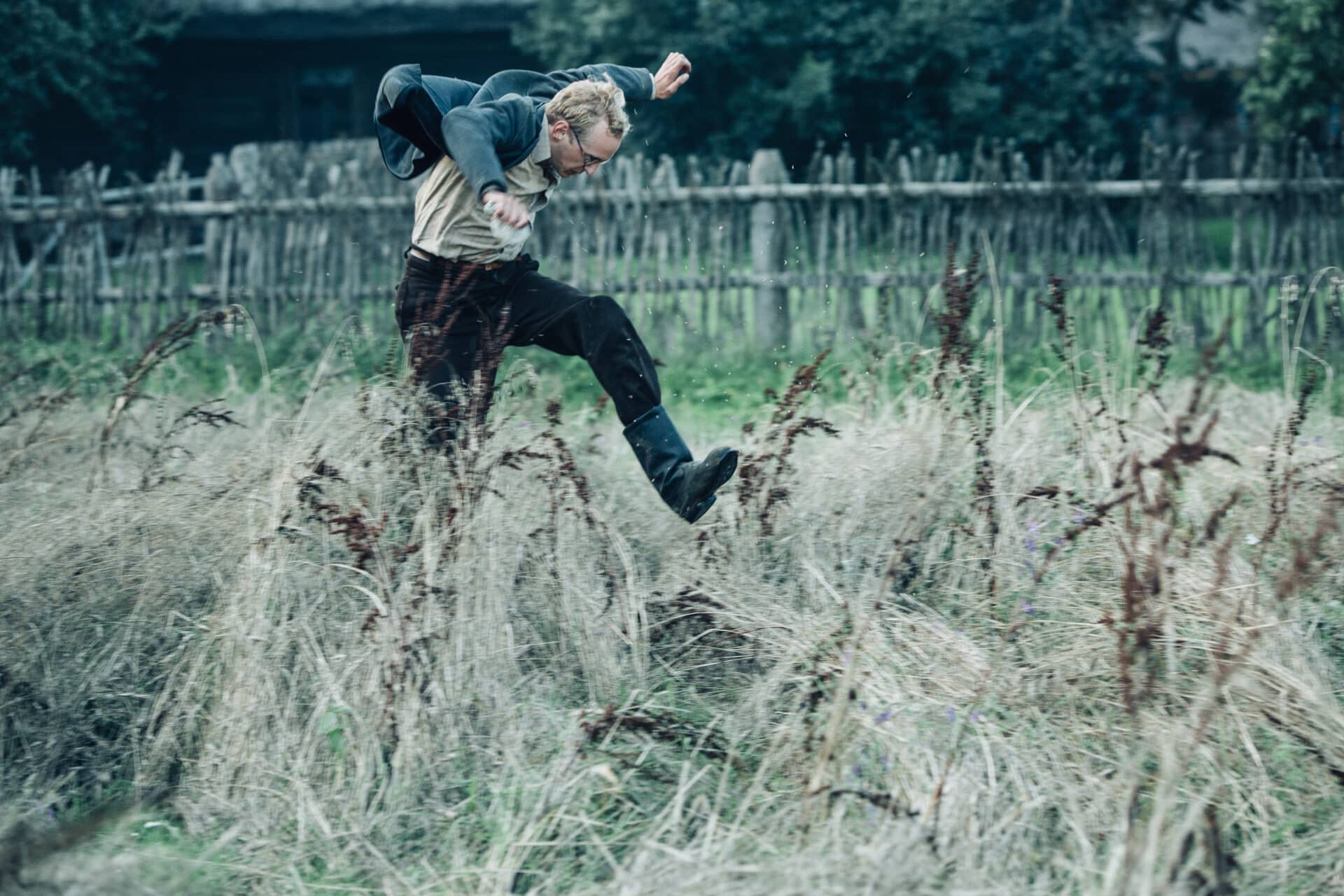
In times of historical upheaval, human choices are rarely simple. Set against the backdrop of war, the Holocaust and post-war Lithuania, director Raimundas Banionis’ film The Purple Mist intertwines love, guilt, betrayal, fear and the need to survive. Yet for the director himself, the story is centred not on major historical events, but first and foremost on the individual – and on the ability to preserve one’s humanity even under the most difficult circumstances.
Released in 2019 and based on a work by writer Feliks Roziner, The Purple Mist will return to the big screen on 13 October as part of the Book + Cinema: Autumn Film Evenings programme at Vilnius Town Hall. It will be the second screening in this year’s series, continuing the conversation about the relationship between literature and cinema, and about how a story born on the page changes when it finds its way into the hands of filmmakers.
Ahead of the film’s return, we speak with director Raimundas Banionis and actress Giedrė Mockeliūnaitė, who plays Janė, about humanity in times of historical turmoil, the choices made by the characters, experiences of the post-war period, trust between director and actor, and what The Purple Mist can tell audiences today.
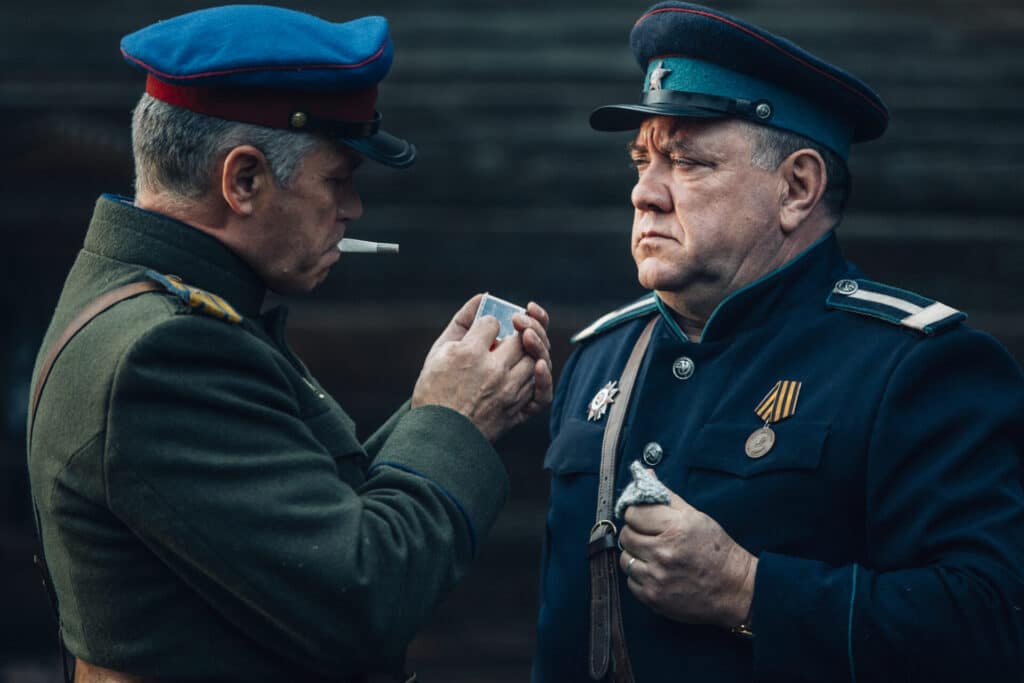
– Raimundas, The Purple Mist is based on a work by Feliks Roziner. What drew you most strongly to this story and made you want to bring it to the screen?
R. Banionis: – What attracted me most was the humanity of the story. During the war, the partisan is driven not only by a desire for revenge – as we see in what he does to the traitor – but also by gratitude for an act of humanity.
– The film intertwines the characters’ personal dramas with a complex historical period – war, the Holocaust and post-war Lithuania. How did you seek a balance between history on a larger scale and the deeply personal fates of individuals?
R. Banionis: – That is the central idea: one must remain human under any circumstances or conditions. That is at the heart of Catholicism.
– Giedrė, Janė lives in a world where personal choices are constantly shaped by historical circumstances. Where did you begin when creating this character?
G. Mockeliūnaitė: – For me, the most important thing is always to understand why a character behaves the way they do: what their circumstances are, where they come from, how they think, what occupies their mind, and what their goals in life are. I try to understand both the conscious and hidden motivations – those that a person may not even be able to articulate to themselves, but which guide them through each day and shape their choices.
When creating Janė, I thought about her inner state, her surroundings, the period she lived in, the people around her and love. What did it mean to be a young woman in Lithuania at that time? What could she expect from life? What did she long for, and what was she afraid of? It is important for me to build as complete a world around a character as possible, so that every action has an inner reason behind it.
– It is easy for audiences today to judge Janė’s choices from the safety of historical distance. Was it important for you not to judge her while creating the role?
G. Mockeliūnaitė: – Of course. An actor cannot judge their character. On the contrary, we have to identify with them and look for answers as to why that person behaves in one way rather than another. We need to understand their motives, fears, longing and weaknesses. For me, it is especially important to find their vulnerability – the things people often try hardest to hide.
What interests me most in cinema, theatre and life is the contradictory nature of human beings. How very different feelings and desires can coexist within a single person. And how often we ourselves believe that, at a particular moment, we are doing the best we can, even though from the outside our choice might look completely different. When creating a character, I try to understand precisely that personal truth.
– Raimundas, at the heart of the film are the relationships between Juozas, Vladislavas and Janė, shaped not only by their own feelings but also by history. What was most important to you when developing the dynamic between these three characters?
R. Banionis: – It was very important that the actors focused on conveying the idea rather than indulging in self-expression. I think they succeeded.
– You entrusted Giedrė with one of the leading roles. What do you remember about working with her, and what were you looking for in the actress who would play Janė?
R. Banionis: – From the very beginning, Giedrė convinced me that she would trust me and do her very best to fulfil the task before her.
– Giedrė, how do you remember that collaboration?
G. Mockeliūnaitė: – First of all, I remember how closely our approaches to acting and cinema aligned. We had a similar way of approaching a character, searching for their motivations and inner life. I felt that the director trusted me, while at the same time I received the criticism and feedback I needed for the work.
I was particularly impressed by the fact that he works differently with every actor. He has a feel for people and understands how to approach them, how to give a note in a way that reaches the actor and helps them open up. To me, that is a very important quality in a director, because we all have different sensitivities and different ways of working.
Working with Raimundas Banionis, I feel safe, positive and professional. That kind of trust gives you the freedom to search, experiment and not be afraid of making mistakes.
– The Purple Mist depicts a period that is no longer part of the personal experience of actors today. How did you find your way into the mindset of someone living in post-war Lithuania?
G. Mockeliūnaitė: – All of my grandparents lived through this period. My grandparents on my father’s side were deported to Siberia, while my mother’s mother – my grandmother – told me many stories about the partisans and about how her family hid in the forests to avoid being found by soldiers and deported. So from childhood, the post-war period was connected in my mind with real people and their experiences.
I also remember how much we studied and discussed this period at school. I think this subject is very close to many Lithuanians of my generation and older generations. We heard about it from our grandparents and encountered it personally through our family histories. In many Lithuanian families, experiences of deportation, loss, hiding and fear have remained.
When creating the role, I was able to draw on those stories and try to understand how such circumstances affect a person’s everyday life: their relationships, their ability to trust, to love, to dream and to think about the future.
– Raimundas, The Purple Mist was released in 2019. When you watch the film today, do you notice things that you interpret differently from when you were making it?
R. Banionis: – My ideas about humanity cannot change. Audiences do not always engage deeply with the meaning behind things. After all, many years ago, in 2001: A Space Odyssey, Stanley Kubrick warned that robots or artificial intelligence could conquer humanity. Yet neither then nor now did anyone pay much attention to it. Humanity now has what it has. The foundations of human existence have been there for thousands of years, and they remain the same.
– The film explores guilt, responsibility, choices and the ways in which a person’s moral boundaries can shift during periods of historical upheaval. Which of these themes feels most important to you today?
R. Banionis: – I think all the themes you mentioned are important. I cannot rank them; I believe that is a personal choice for each individual. What matters is that we do not reject these themes or push them aside.
– Giedrė, how do you see Janė now, seven years after making the film?
G. Mockeliūnaitė: – Of course, today I see things that I would like to explore more deeply, approach differently or develop further. Over those seven years, I have grown and matured, and many things in my life have been turned upside down. I have grown older, gained new experiences and now see many things differently.
I do not know how much that would change my understanding of Janė today if I were to play her again. But I believe there would be another perspective – both for me and perhaps for the audience. It would be interesting to rediscover her and surprise myself in the process.
What is wonderful about cinema is that it preserves a particular moment in time. Even many years later, we can return to that work and remember the state of mind we were in when creating it. That moment has already been captured, even though we ourselves have changed. I think good roles do not end with the premiere – we return to them in our thoughts and discover things we were not yet able to understand before.
– What would you like audiences to take away from The Purple Mist today?
G. Mockeliūnaitė: – I would like audiences to feel how relevant this story remains today. Fear, silence, moral compromises and love under difficult circumstances remain part of the human experience. Circumstances change, but the need to feel safe, to be loved and to preserve one’s sense of self is always recognisable.
I think the most important thing is for the film to raise questions. How many of our choices are truly free? What would we be prepared to sacrifice for safety, or for love? Would we ourselves be as brave as we believe we would be?
Perhaps the film will encourage someone to have a deeper conversation with their family or loved ones and ask them about their lives. My grandmother’s stories helped me understand that history remains deeply personal. Behind it are people we love and experiences whose traces we sometimes carry with us without even realising it.
– Raimundas, this October The Purple Mist returns to audiences as part of the Book + Cinema: Autumn Film Evenings programme. What does it mean to you to see the film return to the screen?
R. Banionis: – As a director, I always want the film to remain accessible to audiences. I am very grateful that Book + Cinema: Autumn Film Evenings has found an opportunity for the film and its audience to meet again.
– Thank you for the conversation!
The Purple Mist will be screened on 13 October at 6 p.m. at Vilnius Town Hall as part of the Book + Cinema: Autumn Film Evenings programme. Following the screening, audiences will be invited to continue the conversation about the film, its story and its themes.
This year’s Book + Cinema: Autumn Film Evenings series consists of three films inspired by Lithuanian literature: on 8 October – Gytis Lukšas’ Vortex, on 13 October – Raimundas Banionis’ The Purple Mist, and on 21 October – Algimantas Puipa’s A Wolf Teeth Necklace.
Tickets for the event are available at bilietai.lt.
Photography may take place during the event.
The project is organised by Fralita Films, the Vilnius Film Office and Vilnius Town Hall. It is supported by the AVAKA association, the Lithuanian Publishers Association and the Creative Europe Desk Lithuania, and is partially funded by the Lithuanian Film Centre.
Stills from the movie The Purple Mist