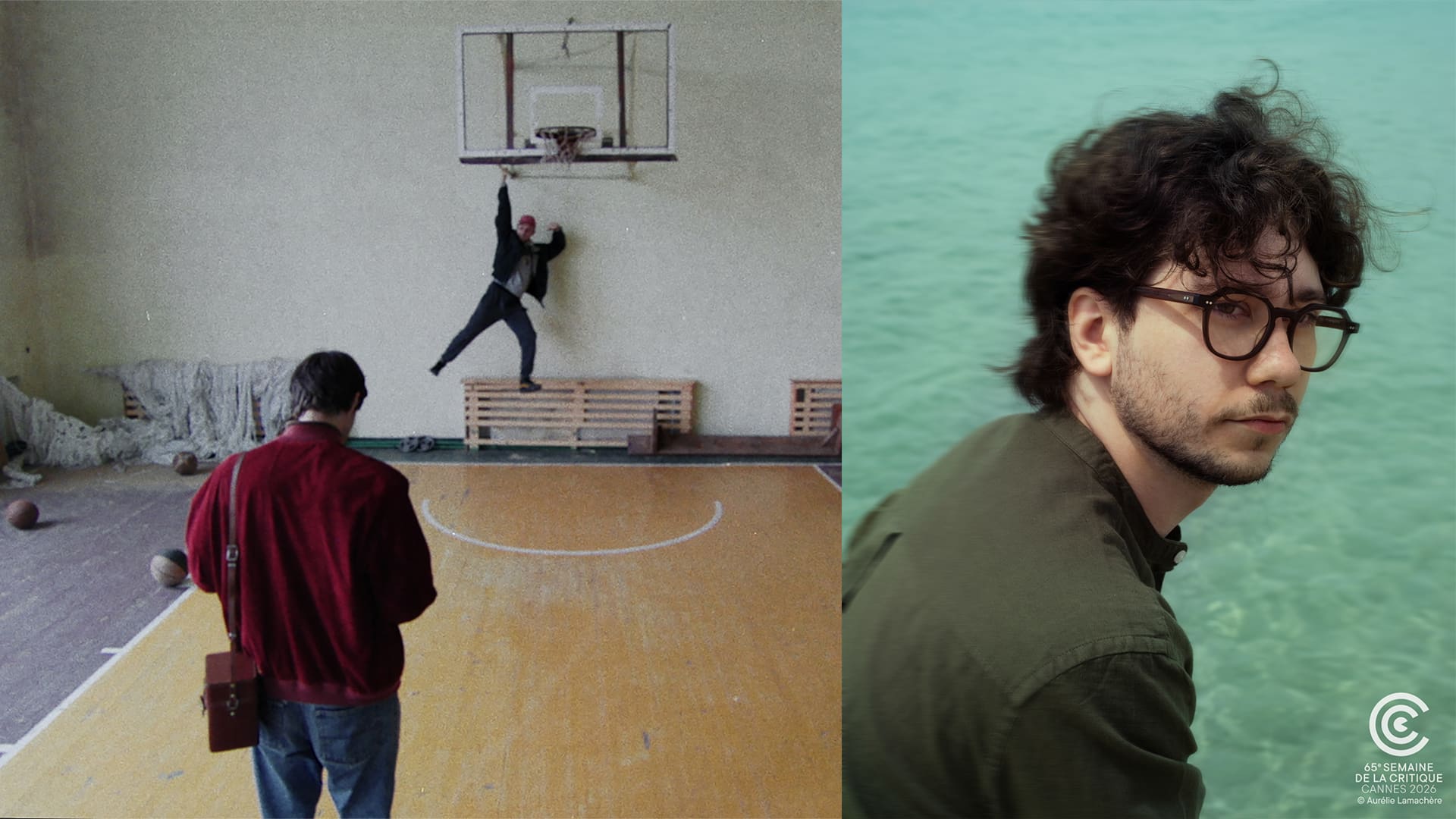
This year, the short film Class Photo by young Lithuanian director Arnas Balčiūnas premiered at the Cannes Film Festival. Created as a master’s graduation project at the Lithuanian Academy of Music and Theatre’s National Film School, the film was selected for the prestigious Cannes Critics’ Week and competed alongside short films from around the world.
The film follows a young man named Ignas who returns to his abandoned school in an attempt to preserve it through photography. It is a story about time, memory, spaces that shape people, and the desire to momentarily stop things from disappearing.
We spoke with director Arnas Balčiūnas about Cannes, student filmmaking, abandoned schools, and why cinema does not always need to explain everything.

– Now that the Cannes premiere and the initial shock have passed – how do you process what just happened?
A. Balčiūnas: It was a very joyful experience during which I had the privilege of seeing inspiring films and meeting inspiring filmmakers.
– Do you remember the moment in Cannes when you first thought: “Okay, this is no longer a dream – this is real”?
A. Balčiūnas: While preparing for the festival, I was also writing my master’s thesis and getting ready for my final defense, so there wasn’t much mental space left to fully process what was happening. The reality of it only truly hit me when I was sitting in the cinema with the audience watching the film.
– Where did the story of Class Photo come from?
A. Balčiūnas: My elementary school in Alytus became abandoned almost immediately after I graduated from it. A few years ago, I visited it again and was overwhelmed by a very strange feeling. The place itself still carried memories, but the abandoned building had already developed stories of its own. In the autumn of 2025, while we were filming the movie, the school was demolished and apartment buildings started being constructed in its place.
That is how the film’s main character, Ignas, was born – a young man trying to preserve his abandoned school through photography. The rest of the story was developed together with actors Džiugas Gvozdzinskas and Mantas Barvičius through an improvisational process inspired by British director Mike Leigh’s method.
– Why was the abandoned school space so important to you?
A. Balčiūnas: The school experience is deeply formative. Even years later, when you no longer keep in touch with your classmates, there is still a certain feeling of connection because you all grew up in the same hallways. At the same time, everyone’s life trajectory later becomes completely different. I’m interested in thinking about how certain experiences at school affect the rest of a person’s life.
– The film speaks not only about memories, but also about trying to stop time. Would you agree with that?
A. Balčiūnas: Absolutely. That idea influenced the film’s visual language – we used wide, mostly static shots. Just like the character Ignas tries to preserve his school through photographs, we also wanted to preserve the place where we were filming.
– In your films, many things remain unexplained. How do you create cinema that works more through feeling than explanation?
A. Balčiūnas: I think things that are not fully understood in cinema often open the possibility to feel something deeper. They extend the viewer’s thinking even after the screening ends. That’s why I try not to explain everything, while also not wanting the audience to leave completely lost. As for emotion – I simply try to honestly convey what I feel myself. Sometimes it works beautifully, sometimes it doesn’t.
– Class Photo was your master’s graduation film. After Cannes, does it still feel like a student film?
A. Balčiūnas: I wouldn’t draw a line between student films and “fully-fledged” works. But of course, success like this at the beginning of your creative journey definitely makes it easier to enter the industry.
– How important is international recognition to you personally? Did Cannes change your confidence as a director?
A. Balčiūnas: I view recognition cautiously because it depends on many different factors. But yes – this experience definitely gave me more confidence. Everything in Cannes felt much more human and approachable than it may appear from the outside. Both the filmmakers and the festival team were incredibly warm and human. It all became more tangible.
– In Cannes, you were competing with films from all over the world. Did being there make you feel that Lithuanian cinema truly stands alongside world auteur cinema today?
A. Balčiūnas: There wasn’t really a feeling of competition at the festival – it was more of a celebratory atmosphere. Lithuanian cinema is unique and interesting, and the achievements at international festivals in recent years prove that. I don’t think we should feel insecure about the size of our film industry – in fact, that can also be a strength.
– Many young filmmakers dream of Cannes, but it feels almost like another planet. What do you wish someone had told you a few years ago while you were making this film?
A. Balčiūnas: Probably nothing, because I would have started overthinking everything and maybe wouldn’t have made the film at all. Now I only know one thing – it’s very important to keep finding the willpower to finish your work all the way through.
– How did the international audience react to the film?
A. Balčiūnas: We were worried that the film would resonate less abroad, but the audience was in a very good mood and people laughed a lot. After the screening, many viewers from very different countries came up to us and shared that they recognized their own experiences in the film.
– Your films pay a lot of attention to spaces, memories, and the fragility of human relationships. Do you feel these are themes you constantly return to?
A. Balčiūnas: Yes. At least for now, these are the themes that interest me the most, and even when I try, I can’t really avoid them.
– After Cannes, did you start feeling pressure – a sense that now you have to live up to expectations?
A. Balčiūnas: I still haven’t had much time to think about it. Those feelings usually come during the active creative process itself, when a lot of doubts naturally arise. But I hope this experience will instead help me stay fearless in telling authentic stories.
– If many years from now you had to remember this stage of your life in one sentence – what would that sentence be?
A. Balčiūnas: Well, I can only hope that many years from now the sentence will be: “It was an important moment, but only the beginning of everything.”
– Thank you for the conversation.
Still by LMTA KIMO, photo by Aurélie Lamachère