Every year, the Lithuanian National Film Awards “Silver Crane” bring together the country’s film community and become one of the most important cinematic events of the year. But this is more than just a glamorous ceremony or an evening of handing out statuettes. It is also an opportunity to pause and reflect on the past year in cinema – to look at it from the outside and define what Lithuanian film has been living through.
The awards reveal which themes stood out, which new names emerged, which films reached audiences, and which remained within a smaller but highly important professional circle. Sometimes this mirror reflects a strengthening industry; at other times, it reveals what is still missing.
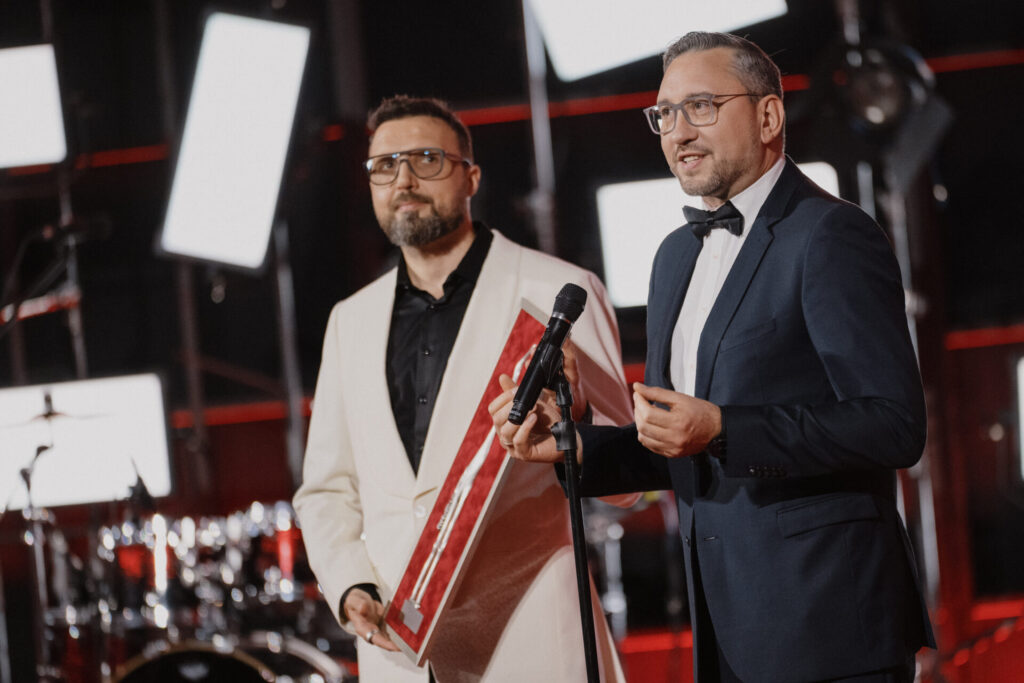
We spoke about this with the organizers of the “Silver Crane” awards – Head of the Lithuanian Film Centre Laimonas Ubavičius and Head of AVAKA Darius Vaitiekūnas.
– How would you define the role of the “Silver Crane” in Lithuania’s film industry today – is it more of a celebration or a mirror of the industry?
D. Vaitiekūnas: – I believe the National Film Awards “Silver Crane” are both. First of all, it truly is a celebration – probably one of the few moments in the year when the entire film community can come together not on a film set, not in a meeting room, not under the pressure of a premiere, but simply to spend time together and celebrate what has been created. At the same time, however, it inevitably becomes a mirror of the industry. The awards show what kind of year Lithuanian cinema has had: which themes became prominent, which new names appeared, which films reached audiences, and which perhaps remained within a smaller but very important professional field.
A mirror is always objective, but sometimes it reflects not only the beautiful things, but also what is still lacking. I think it is important that the “Silver Crane” is not perceived merely as a ceremony. It is a kind of pause in the cinematic year and a chance to say: this is where we are this year, this is what we created, this is what Lithuanian cinema was talking about.
– What message should this year’s “Silver Crane” send about Lithuanian cinema?
L. Ubavičius: – First and foremost, the “Silver Crane” should send the message that Lithuanian cinema today is diverse, engaging, and relevant. Over the past years, it has become increasingly clear that our cinema embraces very different voices and visions – from auteur cinema recognized at international festivals to films that successfully reach broad audiences in Lithuania. This reflects not a single narrow direction, but an increasingly mature and growing film industry.
Equally important is the fact that Lithuanian creators feel more and more confident in the international context – our professionals are becoming equal partners in joint projects with foreign countries, which is perfectly reflected in the steadily growing number of co-productions. Such collaborations not only help Lithuanian films reach wider audiences, but also strengthen trust in the competence and creative potential of Lithuanian film professionals.
At the same time, it is a great opportunity to show that the success of cinema is born from the work of an entire creative team – not only directors, producers, or actors, but also the many people working behind the scenes.

– How has the role of the awards changed over the years – what do they mean to creators today?
D. Vaitiekūnas: – I truly want to believe that today these awards mean more to creators than simply receiving a beautiful acknowledgment on stage. Cinema is a long process. Sometimes many years pass between the first idea and the premiere, years filled with funding searches, creative doubts, and an enormous amount of invisible work. That is why recognition in the eyes of colleagues is extremely important.
And I am speaking not only about directors or actors, but also cinematographers, editors, sound designers, costume designers, makeup artists, production designers, and composers. I think one of the most important functions of the “Silver Crane” is to remind us that cinema is a collective art form.
Another equally important aspect is that awards help films live longer. They can encourage audiences to discover films they may have missed during their premiere release. In a small market, this is especially important, because every additional window of attention for Lithuanian cinema is valuable.
L. Ubavičius: – The role of the awards has evolved together with the film industry itself – as the creative community has grown, the diversity of films expanded, and the visibility of Lithuanian cinema in the international context strengthened. Today, the “Silver Crane” is already more than just a symbolic recognition – it is also a platform that allows us to see what contemporary cinema is living through, which themes are most relevant to creators, which directions are emerging, and how the industry itself is growing.
At the same time, the awards encourage creators to move forward, seek new forms, take on more ambitious projects, and speak about issues that matter to them.
– How can the “Silver Crane” help create a closer relationship between Lithuanian cinema and audiences?
L. Ubavičius: – Every year, the awards become a kind of reference point that allows us to present films created throughout the year more broadly and draw attention to what is happening in Lithuanian cinema today. They encourage discussions about films and the issues explored within them, while also inviting audiences to discover Lithuanian works they may not yet have seen.
Not only the awards themselves but also the nominations play an important role here – they help audiences navigate the cinematic landscape more easily, highlight the strongest films of the year, introduce new names, and reveal the diversity of genres and themes. This is essential in strengthening audience trust in national cinema and building a natural habit of choosing Lithuanian films from a wide repertoire.
At the same time, this relationship is also built on an emotional level – audiences have the opportunity to get to know the people behind the films, understand the creative process, and see how much work lies behind every cinematic project. The more Lithuanian cinema is discussed publicly, the closer, more recognizable, and more relevant it becomes to audiences.
– In your opinion, how has Lithuanian cinema itself changed over recent years – in themes, scale, and ambition?
D. Vaitiekūnas: – In my opinion, Lithuanian cinema has become braver. And in more than one sense. Braver in speaking about difficult topics, braver in searching for its own form, braver in thinking about audiences and the international context.
I believe that over the last decade Lithuanian cinema has grown enormously and become much more diverse. We now have auteur cinema, documentaries, audience-oriented films, debuts by young creators, and international co-productions. Not everything has to share the same tone. On the contrary – the more different voices there are, the healthier the industry becomes.
– How much can the “Silver Crane” contribute to strengthening the prestige of Lithuanian cinema, especially now that Lithuanian films are increasingly traveling to international festivals?
L. Ubavičius: – Today, when Lithuanian films are increasingly traveling to international festivals, the “Silver Crane” also becomes important as a way of more clearly presenting these achievements to local audiences. Often, the film community is the first to learn about the success of films abroad, while the awards help bring these stories closer to a broader audience.
This becomes an opportunity to once again draw attention to the films themselves, the creators, and the stories that represent contemporary Lithuanian cinema, while helping audiences better understand how Lithuanian cinema looks and is perceived internationally.
– How do international projects and success stories change the standards of the local industry?
D. Vaitiekūnas: – I think international projects greatly elevate and transform self-confidence. When Lithuanian creators and professionals work on foreign productions, or when our films travel through festivals, it signals a very clear understanding: we are fully-fledged participants in the international industry.
But this changes not only self-perception – it also changes working standards. International projects often bring different planning methods, different pacing, clearer responsibilities, and higher requirements in production, safety, legal matters, and communication. All of this later returns to the local industry, because the standards and practices gained in such projects are then applied in local and national productions as well.
– How do you see the balance between the awards ceremony as a celebration and as a long-term tool for film culture?
L. Ubavičius: – Over seventeen years, the “Silver Crane” has become not only a highly anticipated celebration for the film community, but also a significant part of Lithuania’s film culture. On the one hand, it is a rare opportunity for the entire industry to gather together, celebrate one another’s work, and celebrate Lithuanian cinema itself.
Moments like these are important for the community, because filmmaking is a long and complex process in which there is often little time to stop and appreciate the journey. However, the importance of the awards goes beyond the ceremony itself. Over time, they become a form of documenting the cinematic process – helping preserve the most significant films, themes, creators, and evolving trends of each year.
– How do you respond to criticism that the awards sometimes fail to reflect the full picture of the industry?
D. Vaitiekūnas: – I think such criticism is completely natural and, as I like to say, what kind of awards would these be if everyone were satisfied? No awards can perfectly reflect the entire picture of an industry. Cinema is far too diverse and subjective for everyone to agree on one definitive list. And this is not unique to Lithuania – it happens all over the world and with all awards.
But I see constructive criticism very positively. It helps us grow, improve, and respond to the questions and ideas raised by the industry. In other words, criticism helps us check whether the processes are clear enough, whether the categories reflect the current reality of cinema, whether the jury is sufficiently diverse, whether we are hearing different parts of the industry, and so on.
At the same time, it is important for me to say that awards are not the entirety of Lithuanian cinema history. They are one frame of the year. An important, visible, symbolic frame — but still just one frame.
Therefore, the goal should not be to pretend that it encompasses absolutely everything, but to strive each year to make that frame as broad, accurate, and sensitive as possible to what is truly happening in Lithuanian cinema.
And finally, I want to celebrate how colorful, exciting, and ambitious the Lithuanian film industry is – how many young creators there are, how many awards are being won at international film festivals, and how many professional achievements are emerging. It is truly wonderful. That is why I invite everyone to celebrate Lithuanian cinema, support creators, discover new talents, and watch the live broadcast of this year’s National Film Awards “Silver Crane” on May 31 via LRT.
– Thank you for the conversation!
2026 Nominees
Best Student Film
AMORPHOPHALLUS (dir. Džiuginta Radavičiūtė, prod. Džiuginta Radavičiūtė, Samanta Molevičiūtė, LMTA National Film School (KIMO))
GLITTER KISS (dir. Augustė Gerikaitė, prod. Lineta Lasiauskaitė, Plopsas, LMTA National Film School (KIMO))
THE LAST SNOW (dir. Sotera Kupinaitė, prod. Gustė Girdvainytė, Džiuginta Radavičiūtė, LMTA National Film School (KIMO))
THE SIGNAL PATH (dir. Eglė Razumaitė, prod. Lineta Lasiauskaitė, Plopsas, LMTA National Film School (KIMO))
WHIRLPOOL (dir. Linas Žiūra, prod. Linas Žiūra, LMTA National Film School (KIMO))
Best Short Film
CONCRETE KIDS (dir. Saulius Baradinskas, prod. Viktorija Seniut-Strolienė)
LOVING (dir. Vesta Tučkutė, prod. Milda Buškevičiūtė)
SIMILAR (dir. Adas Burkšaitis, prod. Greta Akcijonaitė, Kotryna Ramanauskaitė, Ramojus Petrauskas, Aurimas Pukevičius, Magic Film)
AFTER FENTANYL (dir. Rinaldas Tomaševičius, prod. Lineta Lasiauskaitė, Plopsas)
PRA/RASTI PASAULIAI (dir. Aušra Lukošiūnienė, prod. Aušra Lukošiūnienė)
Best Production Design
DONATAS PIRŠTELIS (Danka)
IEVA ROJŪTĖ, LISANNE FRANSEN (The Visitor)
JURIJ GRIGOROVIČ, ALDIS MEINERTS (Two Prosecutors)
NERIJUS NARMONTAS (China Sea)
SIGITA ŠIMKŪNAITĖ (Hunger Strike Breakfast)
Best Make-Up Artist
DALIA BALTUŠKIENĖ (Back to the Family)
GIEDRĖ JAROCKAITĖ, RŪTA PADVELSKYTĖ (Renovation)
JURGITA GLOBYTĖ (Hunger Strike Breakfast)
MILDA PETRUŽYTĖ-GUCEVIČIENĖ (Danka)
TOMASZ SIELECKI, MIRA WOJTCZAK (China Sea)
Best Costume Design
JAWARA ALLEYNE, JUOZAS VALENTA (China Sea)
JUOZAS VALENTA, MORTA JONYNAITĖ, DOVILĖ BALČIŪNAITĖ (The Wall)
MONIKA VĖBRAITĖ (Hunger Strike Breakfast)
MORTA JONYNAITĖ (The Visitor)
RASA TAUJANSKIENĖ (Danka)
Best Composer
DOMAS STRUPINSKAS (Sandbag Dam)
DOMINYKAS DIGIMAS (The Wall)
EDVARDS BRODERS (Renovation)
GEDIMINAS JAKUBKA (Holy Destructors)
PAULIUS KILBAUSKAS, VYGINTAS KISEVIČIUS (Solomamma)
Best Sound Design
JULIUS GRIGELIONIS (The Visitor)
KEN YASUMOTO (Holy Destructors)
LUKÁŠ MOUDRÝ (China Sea)
SAULIUS URBANAVIČIUS (Pociągi)
VLADIMIR GOLOVNITSKI (Two Prosecutors)
Best Editing
ARMANDS ZAČS (Renovation)
DANIELIUS KOKANAUSKIS (Holy Destructors)
EIMANTAS BELICKAS (BIX Almost Nirvana)
IGNĖ NARBUTAITĖ (China Sea)
KOSTAS RADLINSKAS (Danka)
Best Cinematography
AUDRIUS BUDRYS (The Wall)
BARTOSZ ŚWINIARSKI (China Sea)
LUKAS KARALIUS, ALINA LU (Laguna)
VYTAUTAS KATKUS (Holy Destructors)
ZBIGNIEV BARTOŠEVIČ (Danka)
Best Supporting Actress
AISTĖ DIRŽIŪTĖ-RIMKĖ (Renovation)
JELENA KIREJEVA (Hunger Strike Breakfast)
LINA RASTOKAITĖ (Danka)
SAULĖ BLIUVAITĖ (The Visitor)
URTĖ POVILAUSKAITĖ (The Wall)
Best Supporting Actor
ALBINAS KĖLERIS (Hunger Strike Breakfast)
JIAN HUANG (黃健瑋) (China Sea)
JUOZAS BUDRAITIS (Sand in Your Hair)
ROMAN LUTSKYI (Renovation)
SALVIJUS TREPULIS (Danka)
Best Actress
DANGUOLĖ BEINARYTĖ (The Wall)
INETA STASIULYTĖ (Hunger Strike Breakfast)
JŪRATĖ ONAITYTĖ (Sand in Your Hair)
ULA LIAGAITĖ (Danka)
ŽYGIMANTĖ ELENA JAKŠTAITĖ (Renovation)
Best Actor
ARVYDAS DAPŠYS (Hunger Strike Breakfast)
MARIUS REPŠYS (China Sea)
PAULIUS PINIGIS (Hunger Strike Breakfast)
ROBERTAS PETRAITIS (The Activist)
ŠARŪNAS ZENKEVIČIUS (The Wall)
Best Minority Co-Production
TWO PROSECUTORS (dir. Sergei Loznitsa, Lithuanian prod. Uljana Kim)
UNTIL VICTORY! (dir. Valentyn Vasyanovych, Lithuanian prod. Marija Razgutė, M-Films)
SANDBAG DAM (dir. Čejen Černić Čanak, Lithuanian prod. Ieva Norvilienė)
POCIĄGI (dir. Maciej J. Drygas, Lithuanian prod. Rasa Miškinytė)
SOLOMAMMA (dir. Janicke Askevold, Lithuanian prod. Gabija Siurbytė, Viktorija Rimkutė, Dansu Films)
Best Animated Film
BFF. TURBO ADVENTURE MARATHON (dir. Urtė Oettinger, Ignas Meilūnas, prod. Agnė Adomėnė)
CREATION OF WORLDS (dir. Kristina Buožytė, Vitalijus Žukas, prod. Kristina Buožytė, Vitalijus Žukas, Natrix Natrix)
THE PENGUIN AND THE PIGEON (dir. Gertrūda Nemčauskaitė, prod. Justė Beniušytė, Ignas Meilūnas)
TEN (dir. Šarūnas Vyštartas, prod. Akvilė Bliujūtė-Janušė, Meinardas Valkevičius, Meinart)
Best Feature Documentary
BIX ALMOST NIRVANA (dir. Emilis Vėlyvis, prod. Uljana Kim)
HOLY DESTRUCTORS (dir. Aistė Žegulytė, prod. Uljana Kim, Migla Butkutė, Christophe Audeguis, Dominique Marzotto, Lionel Ariel Guedj, Roberts Vinovskis, Dominiks Jarmakovičs)
IRENA (dir. Giedrė Žickytė, prod. Giedrė Žickytė, Ilma Nausėdaitė, Andrius Korvel, Pille Rünk, Martichka Bozhilova)
LAGUNA (dir. Šarūnas Bartas, prod. Šarūno Barto studija Kinema, KinoElektron)
A VILLAGE IN AMERICA (dir. Ramunė Rakauskaitė, prod. Ramunė Rakauskaitė)
Best Screenplay
GABRIELĖ URBONAITĖ (Renovation)
IGNAS JONYNAS (The Wall)
KAROLIS KAUPINIS (Hunger Strike Breakfast)
SAULĖ BLIUVAITĖ (China Sea)
VYTAUTAS KATKUS, MARIJA KAVTARADZE (The Visitor)
Best Director
AISTĖ ŽEGULYTĖ (Holy Destructors)
GABRIELĖ URBONAITĖ (Renovation)
JURGIS MATULEVIČIUS (China Sea)
KAROLIS KAUPINIS (Hunger Strike Breakfast)
VYTAUTAS KATKUS (The Visitor)
Best Feature Film
HUNGER STIKE BREAKFAST (dir. Karolis Kaupinis, prod. Marija Razgutė, M-Films)
CHINA SEA (dir. Jurgis Matulevičius, prod. Ieva Černiauskaitė, Stasys Baltakis)
RENOVATION (dir. Gabrielė Urbonaitė, prod. Uljana Kim, Alise Rogule, Dominiks Jarmakovičs, Kristian Van der Heyden)
THE WALL (dir. Ignas Jonynas, prod. Rūta Jekentaitė, Martynas Mickėnas)
THE VISITOR (dir. Vytautas Katkus, prod. Marija Razgutė, Brigita Beniušytė, M-Films)
Audience Award
HORSE DOMINYKAS’ JOURNEY TO THE STARS (dir. Vytautas V. Landsbergis, prod. Žilvinas Naujokas)
WHEN YOU DON’T EXPECT IT (dir. Vytautas Adomaitis, prod. Julius Balašaitis, Baltas filmas)
LUCKY STARS (dir. Justinas Krisiūnas, prod. Matas Valiulis, Justinas Krisiūnas)
MILLIONAIRE’S ANNIVERSARY (dir. Tadas Vidmantas, prod. Vabalo filmai)
FAMILY IN NATURE (dir. Marius Rimkus, prod. Dagnė Puodžiūnaitė, Rokas Vabalas, Lukas Karpovičius)
Photo by AHOY