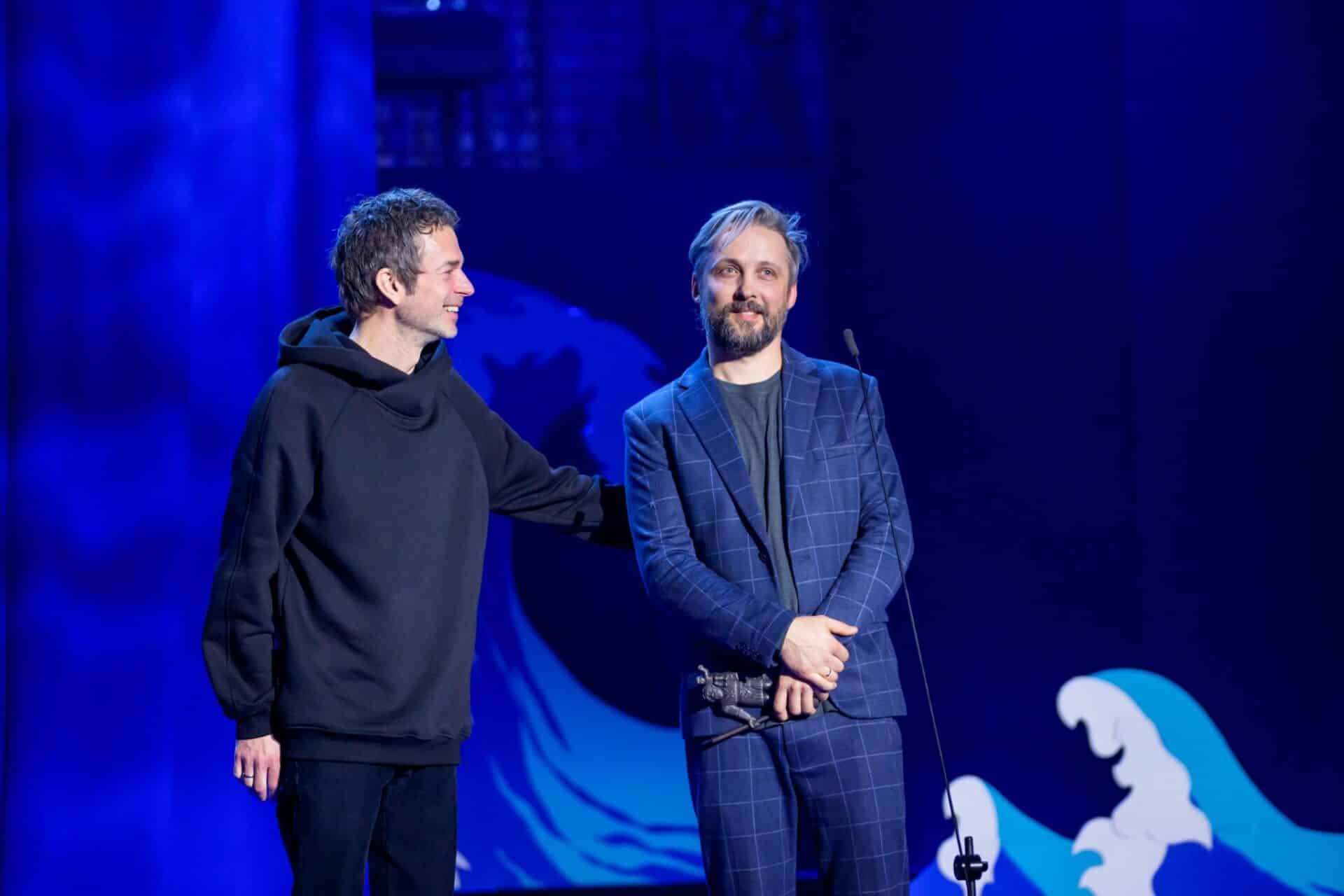
What do you hear when “nothing is happening” in a movie? Sometimes – that’s exactly when everything begins. Composers Paulius Kilbauskas and Vygintas Kisevičius have been creating music for films, commercials, and the stage for over 15 years, but they themselves point out a paradox: the best music in cinema is sometimes… its absence. While working on films like “Solomamma” and “Sasha Was Here”, they seek not only melodies but also what lies between them – the silence, tension, and emotions that cannot be put into words.
We talk with them about how soundtracks are created, why it’s sometimes necessary to forget music, and whether artificial intelligence can replace the creator.
– How did each of you discover music? How did your musical journey begin?
P. Kilbauskas: – When I was five, my parents enrolled me in music school for choir and choral conducting, but as a child I wasn’t very interested in music. When my voice started to break, I no longer fit in the choir, so I had to say goodbye to music school. Then, halfway through my teenage years, around age 15, I developed a passion for music. Where did it come from? I don’t know – maybe from having nothing to do as a teenager back then – and playing the guitar was trendy, so I got hooked. That’s how it all began: we formed a heavy metal band at school, and in 1993, with my friends Darius Šiaurusevičius and the late Kristijonas Karinauskas, we founded the band “Empti.”
V. Kisevičius: – My older brother is a pianist; he was already playing when I was born, so there was always the sound of a piano at home. I started attending music school in fifth grade, and from then on, everything fell into place: music school, conservatory, academy.
– How did you two find each other, and how did your creative partnership come about? How long have you been working together?
V. Kisevičius: – We’ve been working and creating together for about 16 or 17 years, if not longer. We met when I was playing in the band “Pieno lazeriai” and Paulius was in “Empti.” The manager of “Pieno lazeriai” was Paulius’s colleague Olga; they worked together at an advertising production studio. Since Paulius was often away on projects, the studio needed an additional composer, so Olga suggested I join, and that’s how we started working together.
– Are there any composers, pieces, or even genres that have shaped you the most and continue to inspire you today?
V. Kisevičius: – That’s a good question. In one way or another, we’re all like pieces of a puzzle – gathering information from somewhere, influenced by different interests at different stages. In my case, I listened to a lot of jazz at first; I majored in jazz saxophone and played in various jazz ensembles. Later, during my master’s studies, I listened to a lot of classical music, and then came the phase of discovering electronic music.
P. Kilbauskas: – For me, it’s cinema, painting, nature – visuals inspire me more than listening to music.
– About the film “Solomamma”: how exactly did you start working on this film?
P. Kilbauskas: – This film is a co-production – a joint Lithuanian-Norwegian project. Producers from Norway approached Gabija and Viktorija from “Dansu Films” about collaborating. They were presented with options from several composers (including descriptions of the creators and samples of their work), and everything was forwarded to the film’s director, Janicke Askevold, who reviewed all the work and decided who would be the composers for her film. Vygintas and I were chosen. Then came the fine-tuning of details and the creative process. Usually, we work on the music for a single film for about three or four months. Our record is seven months!
– What goes through your mind when you see a scene for the first time – where does the music begin?
V. Kisevičius: – Certain things become clear as soon as I see the first cut. After the screening, you already have a sense of where there won’t be guitars, or where there will be drums, where a melancholic melody or a heart-wrenching composition would fit, and so on. That’s when the creative process begins: composing, arranging, and recording. We try to record almost everything ourselves – both Paulius and I have mastered quite a few instruments. We lay down the basics, and then, if needed, we bring in additional recordings of cello, double bass, vocals, and so on. Of course, there are virtual instruments online, but they sound so “plastic,” whereas in live recordings you can feel the depth and the breath, and the emotion comes across differently.
– The tension in “Solomamma” is very subtle – how much of it was planned, and how much arose naturally?
V. Kisevičius: – The film’s subject matter is not only specific but also sensitive. One of the director’s key goals was not to portray the main character too negatively, to let the viewer decide for themselves who and how… so we definitely avoided tension. But as the story unfolded, that tension did emerge a bit in the music, naturally guided by the film’s plot.
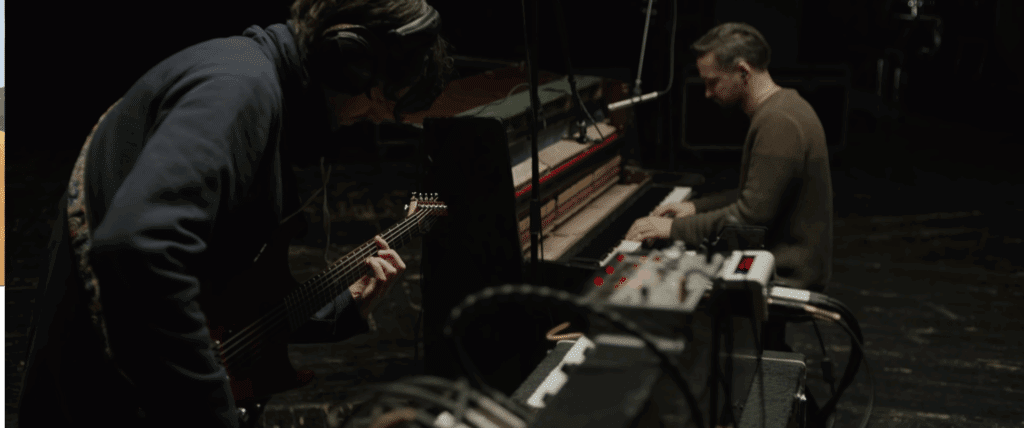
P. Kilbauskas: – To make that tension in the music as gentle as possible, everything was played on an acoustic guitar and piano. One instrument represents the boy, the other the mother. That was the “key” to the music in this film.
– In which movie do you think the music is best?
P. Kilbauskas: – The answer would be a movie without music. Music usually sets the tone in advance or suggests what the viewer should feel while watching a particular scene. But if the film’s screenplay is well-written, everything is filmed superbly, the actors’ performances are flawless, and the sound is meticulously arranged, then music may not even be necessary for such a film, because everything comes across clearly on its own. A good example is M. Haneke’s 2005 film “Caché.” There really is no music in it, but there are sounds. Watching it gave me a “wow” effect; I couldn’t believe that everything could be conveyed so effectively without music. These days, it’s hard to find a film that doesn’t have a lot of music –or even too much.
V. Kisevičius: – It feels like viewers now need to be presented with a lot of everything, quickly and loudly, because otherwise their attention will wander elsewhere.
– How do “Solomamma” and “Sasha was here”, for example, differ in your musical language? What feelings and worlds did you try to create in each of them?
P. Kilbauskas: – The film “Sasha Was Here” – we tried to reveal the light and dark sides of the main character Jurga, played by Gabija Siurbytė, as well as her inner state and emotions. The music for this film was about that, about her. For that purpose, two instruments were chosen: the piano (for the light) and an old “Korg” synthesizer (for the dark). The soundtrack for the film “Solomamma” is more about the relationship between a mother and her son.
– What would be your dream project to work on?
P. Kilbauskas: – I’d really love to work on a horror film, but as soon as I say those words, animation, drama, and everything else that’s a world away from the horror genre “pops into my head.”
V. Kisevičius: – Maybe European cinema is fundamentally a bit different compared to Hollywood; there, the epics, fantasy, and scale are completely different – everything is amplified to the max, while here, everything is more down-to-earth and calmer. Unfortunately, we have neither fantasy films nor horror films, though it would certainly be interesting to experiment musically within these genres.
– What is your relationship with the director during the creative process? To what extent is it a dialogue, and to what extent is it simply following instructions?
P. Kilbauskas: – Directors are people, and people are different, so the relationship is always different each time. With some, I communicate more, while with others, fewer conversations are enough. The most important thing is that they trust us as professionals and respect is always mutual; as for direction, the film itself usually dictates it. The process of creating the music or even the full soundtrack for each film is different. Sometimes we have to send a single scene for approval, but the opposite also happens, where the director comes to the studio just to listen to the final music, even though they haven’t heard anything before, and everything works out perfectly the first time. Just recently, we had another interesting experience working on the Latvian documentary film “Scarecrows” (directed by Laila Pakalnina). We received the rough cut of the film – a completely “raw” version, but without subtitles – so we didn’t understand a thing. All we knew was that the film was about Riga Airport employees who chase animals off the airport grounds – away from the runways and so on. We watched the film; it wasn’t clear what was being said, but emotionally something started to “click,” so Vygis and I decided: “Let’s just go for it and play,” even though we hadn’t even had a conversation with the director yet about the future film music, her vision, and so on. And so, over the course of a few evenings, we played quite a bit, cut together a few hours of music – the parts we liked best – contacted the director and the editor, who were still working on the film, and said: “We’ll send you a lot of music, and you can arrange it in the edit as you see fit.” They took it, arranged it, sent it back to us, we tweaked it a bit as we saw fit, and that was it – the process was complete. The film’s music was finished.
V. Kisevičius: – This was probably the fastest-ever soundtrack created for a full-length feature film, for which we won the Latvian “Lielais Kristaps” award (the equivalent of Lithuania’s “Silver Cranes”) this year for Best Original Score.
– How do you view the impact of artificial intelligence on music creation? Is it a tool or a threat to you as creators?
P. Kilbauskas: – It depends on how you look at it. It certainly can’t do everything; at least for now, AI is probably just a tool for performing some limited function. For example, there are certain AI-powered plugins that help clean up the sound. It’s cool that it opens up possibilities where you can clean up sounds recorded on a phone to sound more or less normal. But AI still struggles with more “artistic” tasks if we’re talking about a truly high-quality result. As for the future – how it will evolve – no one knows; perhaps it will indeed replace certain things. I believe AI tools will be widely used in the advertising market; it’s likely that creating ads will no longer require filming anything anywhere or hiring a “live” composer. We’re already seeing such ads on TV and social media. Perhaps in the future, only very large companies will choose to “actually” film their ads, and this will become something of an exclusive, much like filming on film in the digital age.
V. Kisevičius: – If you’re a creator, what creative joy do you have left after switching to artificial intelligence? If you chose your profession for the sake of creation and you suddenly stop creating, then who are you?
P. Kilbauskas: – As a process-oriented person, the creative process itself is very important to me. And if I use artificial intelligence to generate music, it will take away all the pleasure from me.
– Thank you for the conversation!
The photograph accompanying this release is provided from the interviewee’s personal archive