The Vilnius Film Office presents the video series Films That Changed the History of Lithuanian Cinema. Through conversations with directors, actors and those who witnessed the industry’s evolution first-hand, the series explores not only events of the past but also the growth and maturation of Lithuania’s film industry over 35 years of independence – the films that marked turning points and those that became bridges to the international stage. Major awards, the first international productions in Lithuania, bold themes, twists of history and the determination to speak through a different cinematic language – this is a story of cinema that grew alongside Lithuania.
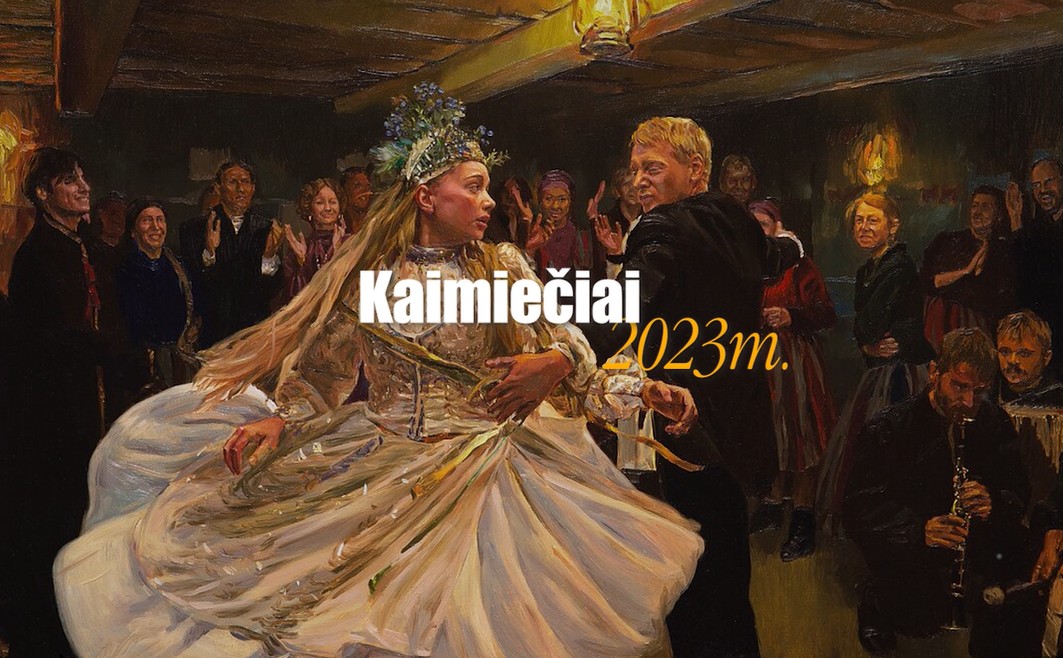
Released in 2023, the animated film The Peasants is based on Władysław Reymont’s novel of the same name, written more than a century ago. Although the literary work dates back to the beginning of the 20th century, the film’s co-producer Agnė Adomėnė notes that the social issues it explores remain relevant today. It is precisely this ability to address universal themes that allows works such as this to transcend the era in which they were created.
The Peasants was also Adomėnė’s first experience co-producing a feature film – and one of extraordinary scale from the outset. The €7 million production involved three countries, with animation studios operating across four. Both the production model and the technique itself were highly ambitious: live-action footage was transformed into hand-painted animation.
A single second of the finished film required 12 individually painted frames. On a highly productive day, one artist could complete around two frames; two and a half was considered an exceptional result. This meant that even after an entire working week, a single artist might still not have produced one full second of the finished film.
Painter Jolanta Spangevičiūtė and art departament supervisor Aistė Kanapickaitė explain that details take on particular importance in painted animation. Hands, faces, folds of clothing, the way light falls, and even the sequins on a wedding dress had to be repainted in every frame while maintaining fluid movement. Something the audience sees on screen for only a fleeting moment could represent many hours of meticulous work for an artist.
At the same time, not every frame could be treated as an individual painting completed down to the smallest detail. In animation, it was essential to understand what each particular scene required. In sequences involving rapid movement, greater emphasis was placed on the movement itself and on smooth transitions between frames, allowing for less detail. Close-up portraits or scenes with very little movement, on the other hand, demanded far greater precision.
The artists’ creative freedom was shaped by a clearly defined directorial vision. Even before the main work began, precise colour palettes and a specific painting style had been established, along with visual references for artists working across different studios. The primary goal was to ensure that frames painted by many different hands would ultimately come together on screen as one coherent visual world.
Yet completely eliminating each artist’s individual touch was neither possible nor necessary. Because every frame was painted by hand, subtle traces of personal style and emotion inevitably remained. According to the artists, these slight differences became part of the film’s visual beauty.
At the beginning of the process, the artists also had to learn to recognise when a frame was truly finished. Their work was continuously reviewed and approved by managers, supervisors and directors. Over time, however, as the artists became familiar with the film’s rhythm, visual language and required level of detail, the process became more intuitive. Experience allowed them to understand more quickly what each frame required and when it was ready to become part of the final animation.
The international nature of the production added another layer of complexity. Different scenes were filmed in different countries and at different times, with some involving large-scale setups featuring crowds of people, horses and elements of rural life. Filming and reshoots continued even after the painting process was already well underway, meaning that the filmmakers constantly had to coordinate material being created at different stages and in different locations.
For Adomėnė, the more than two years spent working on The Peasants now feel like a kind of diary. Watching the film, she remembers not only how particular scenes were created but also the life unfolding inside the studio at the time – conversations with artists, works of art she shared with them as sources of inspiration, friendships, love stories and conflicts. In this sense, the film’s running time contains not only the story visible on screen, but also countless personal experiences that remained behind the scenes.
The Peasants attracted particularly large audiences in Poland, the production’s lead country, where more than 1.5 million people saw the film in cinemas. Yet its significance lies in more than audience numbers alone. It was a vast undertaking built around human craftsmanship at a moment when the audiovisual industry itself was beginning to change at extraordinary speed.
The Peasants reached cinemas in 2023 – at the same time that discussions surrounding artificial intelligence and its possibilities were becoming increasingly prominent across the creative industries. Adomėnė reflects that this placed the film at a unique technological crossroads: some viewers even questioned whether animation on such a scale could truly have been created by hand.
Yet it is precisely this craftsmanship that lies at the heart of The Peasants. Behind every second that passes on screen are twelve individually painted frames; behind each frame are a person’s hand, time and skill. The film therefore captures not only the world Władysław Reymont created more than a century ago, but also a very particular moment in filmmaking – a time when contemporary international animation could still be created through thousands of paintings made by hand.