The Cannes Film Festival has remained one of the most important platforms in the global film industry for decades. It is where the year’s biggest premieres are born, cinematic trends begin to take shape, and the festival’s competition lineup often becomes a kind of roadmap for the film year ahead. Yet today, Cannes is not only a celebration of cinema, but also a complex system of industry, prestige, politics, and business.
We spoke with film critic Dmitrij Gluščevskij about whether Cannes still dictates the direction of cinema, how festival films are changing, what role film critics play today, and why this year’s Cannes marks a historic success for Lithuania.

– Does the Cannes Film Festival still dictate cinema trends today, or does it merely reflect them?
D. Gluščevskij: – I think Cannes is still the platform where the most important films begin their journey. You can measure this quite objectively by looking at how many films screened at Cannes later appear throughout the “BAFTA”, “Golden Globes”, or “Oscars” season. So far, Cannes is still the place that most consistently gathers the films that ultimately go all the way to the finish line. Of course, the Venice Film Festival has become a major competitor, especially when it comes to Hollywood productions. But in the context of European cinema, Cannes remains unmatched. On the other hand, it is difficult to separate whether Cannes truly gathers the best films or simply possesses the strongest machinery for building momentum around film productions. These things are closely intertwined.
– How important is cinema itself in Cannes, and how much of it is film politics?
D. Gluščevskij: – Film politics definitely exists in Cannes. Certain relationships have been established between the festival and major international distributors under the current festival director Thierry Frémaux. Some names or companies enter Cannes more easily. Sometimes weaker films also make it into competition simply because they come attached to a strong director’s name. But in a way, this is natural. Festivals operate like ecosystems – they work with filmmakers and distributors they trust, who consistently create work and attract attention. In this sense, Cannes is a very clearly structured mechanism.
– Cannes is often associated with cinema magic. Does the festival itself still have that special atmosphere?
D. Gluščevskij: – Interestingly, Cannes is not the coziest or most pleasant festival for me personally. It’s not a place where you feel surrounded by romantic cinephilia. Cannes is business. There’s a lot of work, very little sleep, and many people who arrive there not to relax, but to work.
The city itself sometimes feels like “Palanga for very wealthy people” – full of kitsch, performative luxury, and money. But people don’t go to Cannes because of that. They go to be the first to see the films the whole world will soon be talking about. And that feeling – standing in line for hours to see a film nobody has seen yet – is still something special.
– Which festival feels closest to your ideal?
D. Gluščevskij: – One of the most beautiful festivals to me is Bologna’s archival film festival “Il Cinema Ritrovato”. There is real cinema celebration happening there. The festival is very democratic and open, and it’s easy to talk about cinema there.
From the outside, it may seem snobbish because it screens archival or niche films, but in reality there is a lot of love for cinema and very little industrial pressure. Cannes emphasizes industry and influence, while Bologna emphasizes the joy of watching films.
– In recent years, there has been a lot of discussion about the conflict between festival cinema and streaming platforms. Does this divide still exist?
D. Gluščevskij: – Cannes protects that divide very clearly. One of the main requirements for entering the festival is that a film must be screened in French cinemas. This is why there has been a long-standing conflict between Cannes and Netflix.
Streaming platforms are primarily focused on attracting viewers into their own systems, so they are not always interested in traditional theatrical releases. Cannes, meanwhile, strongly defends the traditional logic of film distribution: first cinemas, then the internet and television.
At the same time, streaming platforms still need the prestige of festivals. If they didn’t, they would simply release films directly on their platforms and that would be the end of it. But within the industry there is still an understanding that recognition requires premieres, festivals, and physical cinematic experiences.
– What major changes have you noticed in the Cannes program over the past decade?
D. Gluščevskij: – Changes are happening, but they are not radical. For example, today we see more women directors in the main competition than before, along with more diverse identities and themes.
At the same time, Cannes remains fairly conservative. The festival still heavily relies on established names like Pedro Almodóvar, Cristi Puiu, Nuri Bilge Ceylan and others with whom the festival leadership has maintained relationships for years.
Cannes tends to choose a safer model: it is often considered better to select a slightly weaker film by a well-known director than to take a major risk on a completely new name. This is tied to press attention, prestige, and long-term relationships.
– Is festival cinema becoming too safe today?
D. Gluščevskij: – Sometimes it really does feel like there could be more risk and surprise. But at the same time, I don’t think every Cannes film has to be a masterpiece. Today we live in a time when world cinema is extremely accessible – both legally and illegally. Because of this, unrealistic expectations emerge that every festival film must completely overwhelm audiences. In reality, cinema needs room to breathe. Talented directors should be allowed to make more average films too. Critics sometimes forget that filmmakers also live under enormous pressure.
– How much of a festival’s success depends on the film itself, and how much on marketing?
D. Gluščevskij: – At festivals, everything matters: when the film is screened, what slot it gets in the program, how communication is handled, what atmosphere is created around the premiere. But even with very strong marketing, it is impossible to force people to love a film. Sometimes the smaller, less advertised films become the biggest discoveries of the festival. Journalists are always waiting for those “dark horses” – films nobody expected anything from, but which suddenly become the talk of the festival.
– Which Cannes film has left the strongest impression on you?
D. Gluščevskij: – One of my strongest experiences in recent years was Julia Ducournau’s film “Titane”. Many people left the screening quite skeptical, but I personally loved it. It was physical, strange, unconventional, a bold mix of genres. And I was very happy when it later won the Palme d’Or. It’s always exciting when a film you believe in ends up being recognized.
– How is the role of the film critic changing today?
D. Gluščevskij: – Today everyone can share their opinion about a film, so it’s no longer enough for critics to simply say “I liked it” or “I didn’t”. I think the critic’s role today is to provide context – to show where a film comes from, how it connects to film history, and what cinematic tools it uses. Critics should help audiences not only consume cinema, but also understand it. Of course, there is always the risk of appearing too intellectual or disconnected from viewers. But I believe it’s possible to write intelligently while still remaining accessible.
– How do you evaluate the visibility of Lithuanian cinema at international festivals?
D. Gluščevskij: – I think Lithuania is moving in a very good direction right now. This year we have three films connected to Lithuania in Cannes – and that is a huge success. The films “Spring”, “Class Photo”, and also “Ulya”, which involves Lithuanian filmmakers, have all been selected for various programs. These are no longer isolated coincidences, but signs that Lithuanian cinema is becoming visible internationally. At this point, it almost doesn’t matter whether all of these films are equally strong. Simply being present at a festival like Cannes opens many doors for the future.
– What is Lithuanian cinema still lacking?
D. Gluščevskij: – When it comes to festival cinema, I would say almost nothing is lacking anymore. Lithuanian cinema is already reaching major festivals. However, I think we still need stronger commercial cinema. Lithuania still lacks quality films aimed at broader audiences that are not simply fast-consumption products. We already have many very strong festival filmmakers, while the commercial segment is still searching for its quality standard.
– What makes a film good for you personally?
D. Gluščevskij: – A good film for me is one where there is harmony between what it says and how it says it. When form and content work together. At the same time, I have a kind of professional deformation – I often find an imperfect but risky film more interesting than a technically polished but completely safe one.I would rather watch a film that irritates or surprises me than one I forget immediately after leaving the cinema.
– Can cinema still surprise us today?
D. Gluščevskij: – I think it absolutely can. Even if it sometimes feels like we’ve already seen everything, a truly great film can still affect you emotionally. It can make you laugh, cry, or leave the cinema feeling uplifted. Cinema may no longer be the single dominant art form, but it is far from outdated. When a film is truly great, that cinematic magic still works just as powerfully.
– Thank you for the interview!
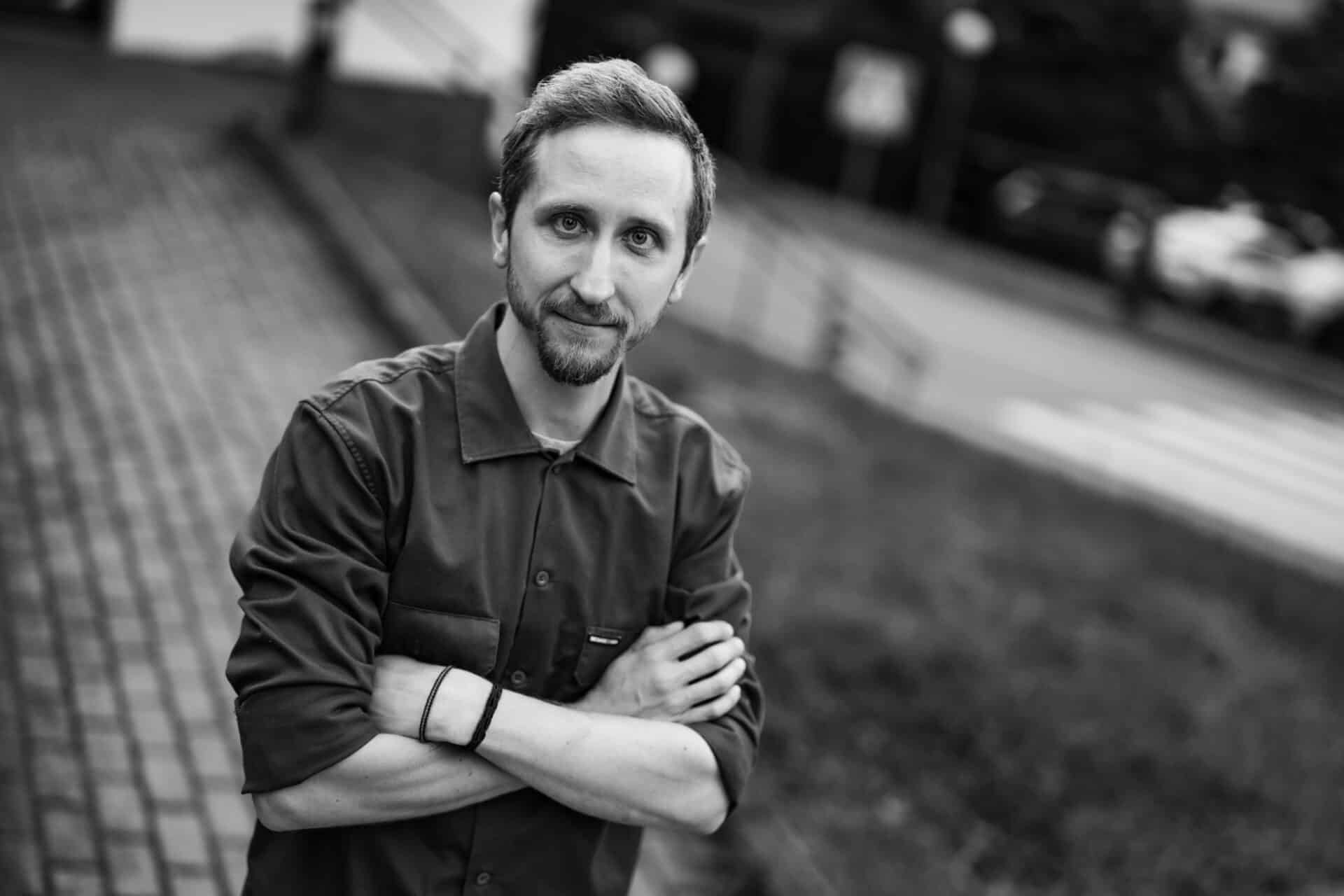
Photo by Domas Rimeika