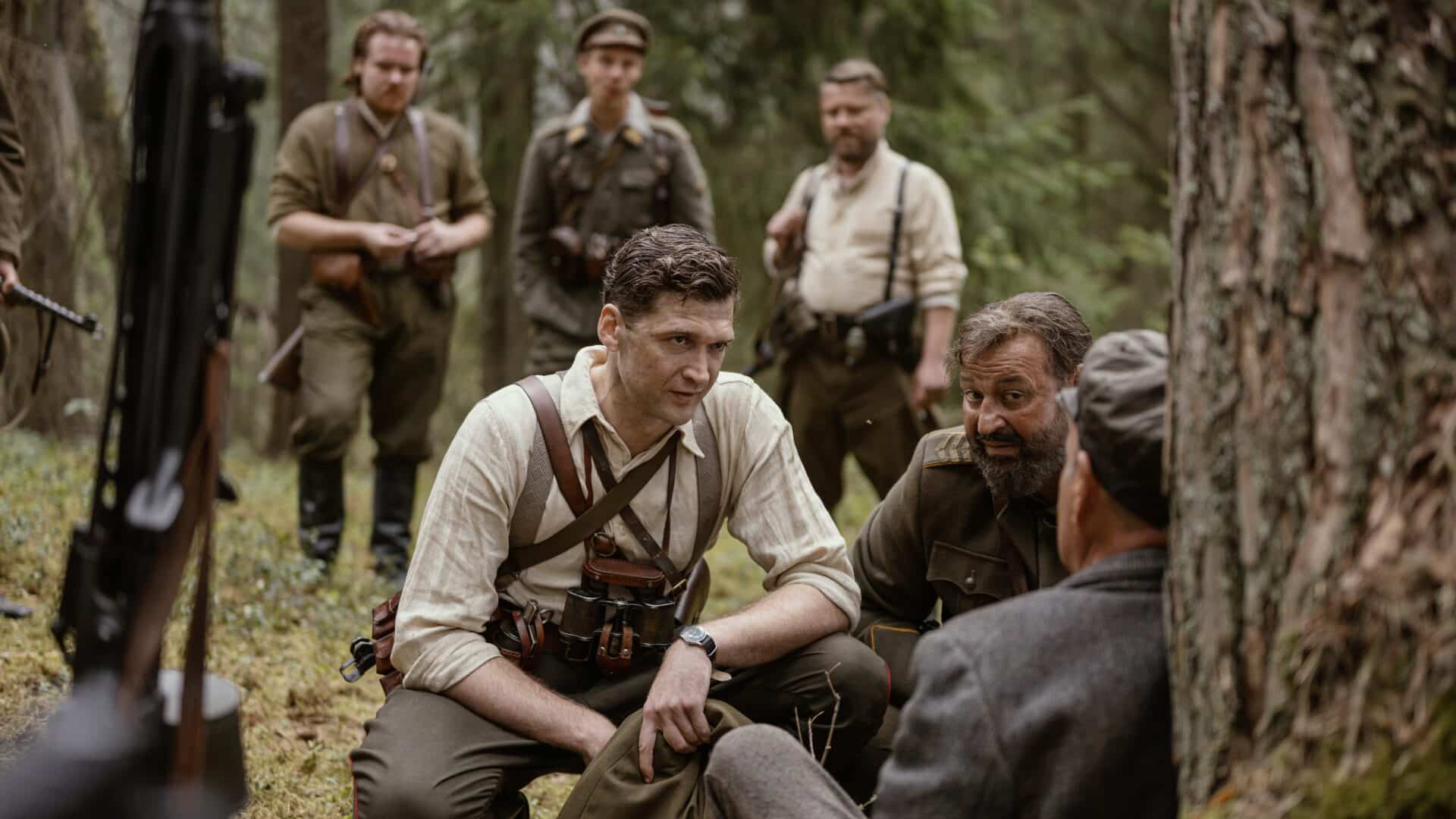
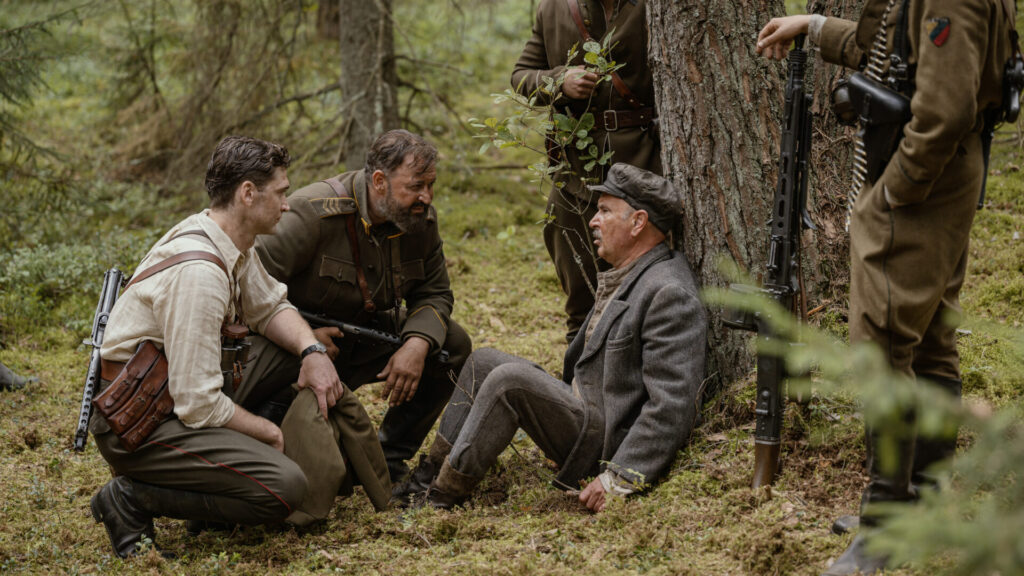
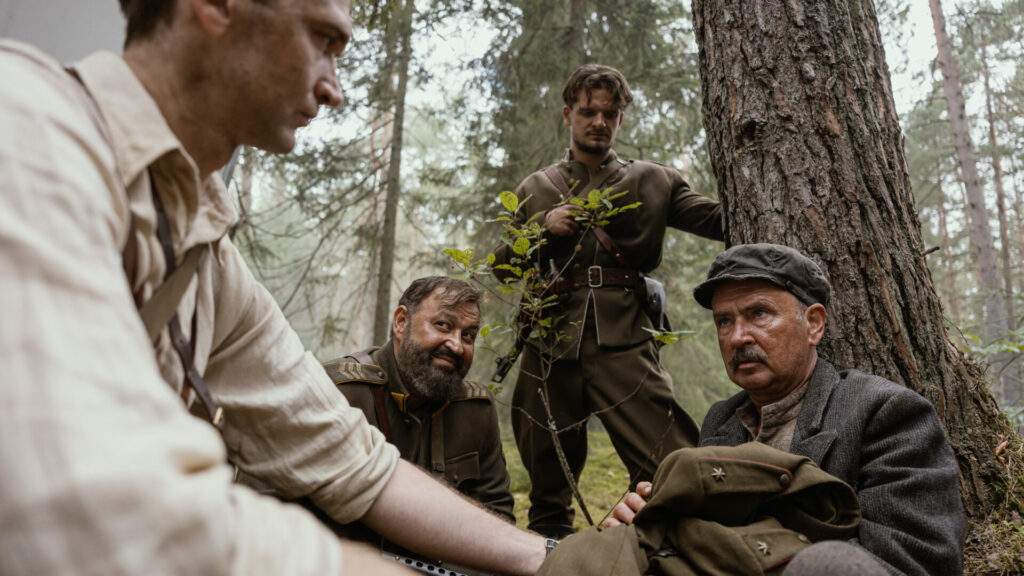
Director Emilis Vėlyvis is currently shooting his new historical film “To Catch a Hawk”, set in post-war Lithuania during the period of armed partisan resistance. Yet the filmmakers are not interested solely in historical events or armed struggle. At the heart of the story are people – their choices, relationships, and the price they were forced to pay for freedom.
Kęstutis Cicėnas takes on the lead role of Adolfas Ramanauskas-Hawk, joined on screen by Džiugas Grinys, Liubomiras Laucevičius, Lukas Malinauskas, Elzbieta Luotė and other prominent Lithuanian actors.
Recreating this historical world begins with details that may barely register on screen – fabrics specially dyed and aged, custom-cast buttons and woven insignia – and extends to large-scale sets, night shoots, battle scenes and complex lighting solutions. The crew already jokes that “To Catch a Hawk” has become “the crane film”: tens of thousands of euros have had to be allocated to cranes used to support lighting equipment alone.
We speak with the film’s producer, Daiva Varnaitė-Jovaišienė, about portraying the partisans not as a single historical symbol but as distinct individuals, Emilis Vėlyvis’ distinctive filmmaking style in the context of a sensitive subject, the boundaries of historical accuracy, and why “To Catch a Hawk” is also a deeply personal film for her.
– “To Catch a Hawk” is presented as a historical epic, yet at its heart is not history itself, but people forced to decide how much freedom is worth to them. When making a film of this scale, what was more important to you personally: recreating the period as accurately as possible, or making it understandable to someone whose knowledge of the partisan war comes only from history books?
D. Varnaitė-Jovaišienė: It is important to the entire team that these two things work together. The screenplay is based on professional historical research, archival documents, and the memories and testimonies of people who are still alive today. But accurate details alone do not make a film. We want the audience to understand not only what happened, but why young people chose to fight, what an oath, trust and personal happiness meant to them, and the pressures they faced.
For me personally, this film is deeply personal. I am the daughter of a deportee, and I never had the opportunity to know a large part of my family and relatives – some were deported, others killed, their property confiscated, while the fate of some of my relatives remains unknown to this day. That is why this film matters so much to me, and why I approach it with sensitivity, great respect and a strong sense of responsibility.
– In Lithuania, we already have a fairly established collective image of the partisans – the forest, the bunker, the uniform, the weapon. Were there things you deliberately chose to avoid simply because they felt too familiar or overused?
D. Varnaitė-Jovaišienė: Although first and foremost this will be a dynamic Emilis Vėlyvis film full of action and tension, we are deliberately trying to move away from the familiar portrayal of partisans that audiences have already seen many times in previous works by Lithuanian filmmakers. We do not want to repeat the same forms of storytelling.
Our aim is to find different perspectives and new angles through which to portray the events, the world and the people of that period. For them, the forest is simultaneously a space of freedom, a temporary home and a constant trap. Alongside heroism, there is fear, humour, love, jealousy, exhaustion, doubt and different understandings of responsibility. We want audiences to see the partisans not as a single, generalised historical archetype, but as very different, living people who were forced to make extraordinarily difficult decisions.
– Alongside Vanagas, the film features a number of other partisans – Cancer, Gramps, Lightning, Bear, Aspen, Birch and others. In a story filled with men, uniforms and codenames, how do you make each of them feel like an individual rather than simply another fighter in the forest?
D. Varnaitė-Jovaišienė: I think it is a mistake to perceive the partisans as a homogeneous group. They were people of very different ages, educational backgrounds, professions and life experiences. Before retreating to the forests, they were farmers, teachers and students; they worked, built families and raised children. Each of them had to leave behind a different life they had been building until then.
That is why, in the film, we are trying to portray distinct personalities rather than a generalised portrait of a partisan – their temperaments, values, doubts and relationships with others. These people did not necessarily think alike or always agree with one another, but they were united by something fundamental: a common goal. We want to convey that unity does not mean uniformity. Very different people can remain together when they share a sense of responsibility for their country and its freedom.
– Which creative decision seemed fairly harmless on paper, only for you to realise once you began implementing it: “Right, we’ve really created some work for ourselves here”?
D. Varnaitė-Jovaišienė: It can sometimes seem as though a director first writes a screenplay, lays out their entire vision for the film, and only afterwards do the producers read it and start figuring out how to make it happen. But in the European film production system, the process generally works differently. From the very beginning of a project, we already have an approximate idea of the budget we can raise, so the screenplay and the director’s vision are developed through continuous discussion between the director and producers.
Every significant creative decision is evaluated not only in terms of its artistic value, but also in relation to the actual financial and production possibilities. From the outset, the director works within clearly defined conditions, constantly setting priorities and, one could quite openly say, keeping their creative ambitions in check. So the idea that a film is the unrestricted realisation of a filmmaker’s imagination seems very far removed from the reality of film production to me.
Still, even with meticulous planning, there are things whose true scale only becomes apparent once technical preparations begin. We already joke that “To Catch a Hawk” is “the crane film”. We have a great deal of forest and open terrain, quite a few night scenes, and in the NKVD building we were only able to construct the set on the second floor. All of this creates complicated lighting challenges. Initially, we considered mounting some of the lighting equipment on trees or existing structures, but after technical assessments we realised that these solutions would neither create the atmosphere we wanted nor give us sufficient control over the light.
Across many shooting days, we need to maintain a consistent lighting atmosphere regardless of whether the sky is clear or overcast, or whether it is raining. Footage shot on different days must later connect seamlessly in the edit, so lighting continuity is essential.
This requires large cranes to support the lighting equipment, and some scenes require several of them at once. Since many of the locations are some distance from Vilnius, the cost of rental is compounded by transporting the equipment, working hours and all the logistics involved in operating it. Because our need for cranes increased considerably, we had to redistribute expenditure across different departments. I can openly admit that on previous projects we have never had to allocate tens of thousands of euros to cranes, and at the beginning of planning we certainly did not expect to need so many.
– In historical cinema, audiences are quick to spot something that feels fake – a uniform that is too clean, a village that looks too perfect, or “cinematic dirt”. What is the authenticity test for “To Catch a Hawk”? How do you know when the world begins to feel lived-in rather than constructed for a film?
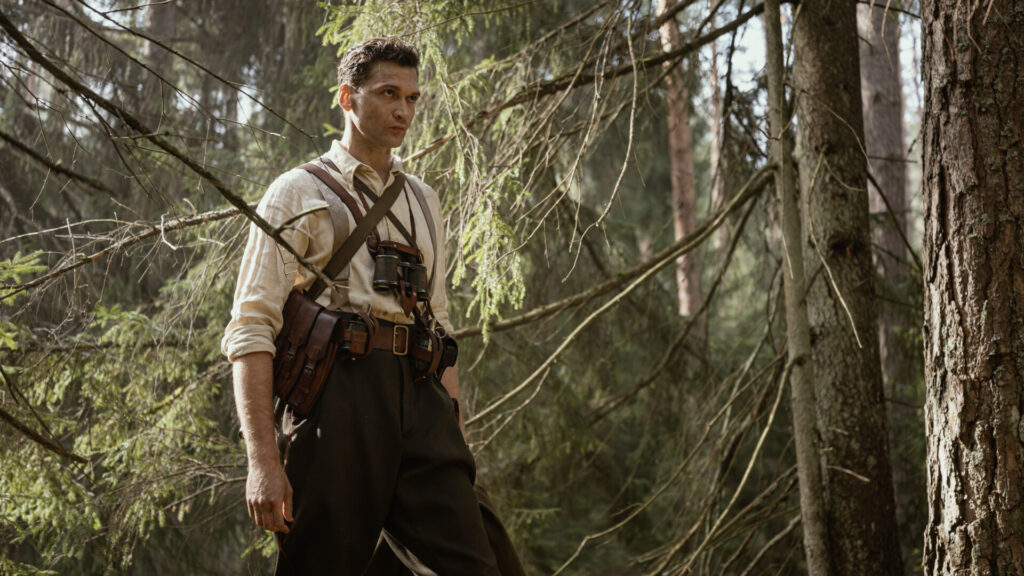
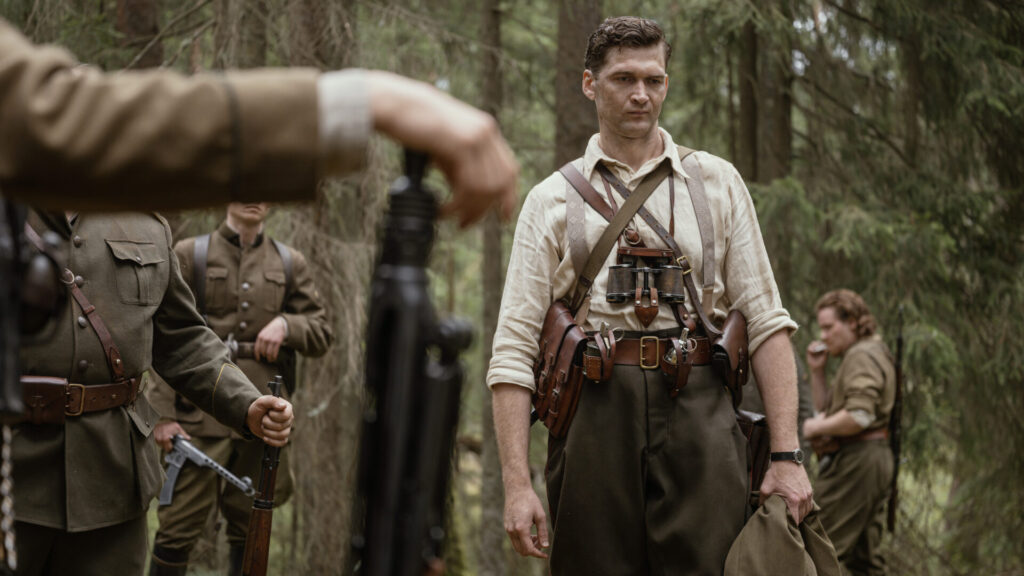
D. Varnaitė-Jovaišienė: In a historical film, authenticity is created by thousands of carefully coordinated details. We purchased fabrics for the costumes, which were then specially dyed and aged; buttons were cast, insignia woven and patches made. The colours were selected with great precision – the shades of the partisans’ costumes needed to differ from those worn by NKVD officers while still creating a harmonious image on screen.
Costume designer Daiva Petrulytė created the costumes not only according to the historical period but also around the personalities of individual characters. Their silhouettes, details and levels of wear differ so that the audience can easily distinguish between different personalities even when everyone appears to be wearing similar uniforms.
The sets are being created with just as much attention to detail. Production designers Ramūnas Rastauskas and Raimundas Dičius built a large post office set in Rumšiškės, helping to create the impression of a living post-war Lithuanian town. We created the NKVD interiors in an abandoned hospital building in Vilnius – it had to be transformed and repainted, with offices, corridors and interrogation rooms constructed and filled with period-appropriate details.
Because this is not only a historical film but also a war and action film, weapons, shootouts and actor preparation are extremely important. We use weapons appropriate to the period, while military expert Ernestas Kuckailis advises the actors and prepares them for the battle scenes.
Nevertheless, we are making a feature film, not a documentary reconstruction. Some historically accurate ways of holding or firing weapons could pose a risk to an actor’s eyes, face or hearing, as well as to those around them on set, so these actions are adapted to modern safety requirements. The audience should not notice a newly cast button, a specially aged wall or the technical solutions required to shoot a gunfight. They should simply believe that what they are seeing is a living, breathing world of post-war Lithuania.
– We are used to a very distinctive directorial style in Emilis Vėlyvis’ films. What happens to that style when it encounters a subject that is approached with great sensitivity in Lithuania and which, for many people, is not simply “historical material” but part of their family’s personal tragedy and memories?
D. Varnaitė-Jovaišienė: Emilis has been our creative partner for many years, so we know very well his ability to create films that are cinematically powerful, dynamic, emotionally affecting, inspiring and engaging for a broad audience.
There is no need to suppress his energy or his strong visual thinking here – they help prevent the story from feeling like a museum piece. Emilis certainly feels the responsibility that comes with the subject, because he understands how particularly sensitive it is, and it is important to him to maintain respect for people whose families do not regard these events as distant history. His distinctive style will serve the truth and the human drama rather than provocation for its own sake.
– The film brings together a number of well-known Lithuanian actors, from Kęstutis Cicėnas and Džiugas Grinys to Liubomiras Laucevičius, Lukas Malinauskas, Elžbieta Girkantaitė and others. Was there an actor you saw in a particular role and thought: “I didn’t expect this person here at all, but now I can’t imagine anyone else playing the part”?
D. Varnaitė-Jovaišienė: We trust all the actors involved in our project. It would be difficult to single out one talented actor – they are all highly dedicated professionals who love what they do. However, during the casting process for the role of Vanagas, Kęstutis Cicėnas stood out for his ability to convey not the outward image of a historical figure, but his inner logic and humanity. He was very well prepared and had immersed himself in the circumstances of Vanagas’ life and the choices he made, so it quickly became difficult to imagine anyone else in the role.
I would also single out Džiugas Grinys, who plays Cancer. It is an exceptionally complex and dramatic character, which Džiugas portrays with sensitivity, precision and great conviction.
– If, after the premiere, historians began debating one particular scene and that same scene was the one audiences remembered most vividly, would you see that as a problem or as a sign that the film had done its job?
D. Varnaitė-Jovaišienė: Discussion in itself would not be a problem – historical cinema often encourages it. But it is important to emphasise that we are not making a documentary reconstruction. We are making a feature film inspired by real events and historical figures. We have researched the facts in great depth, consulted historians, and analysed archival material and testimonies, but within the limited running time of a film it is impossible to reconstruct every event in detail or portray every person who took part in them.
For that reason, some events are condensed, their timing or circumstances are slightly altered, while traits belonging to several historical figures may be combined into a single character. For example, the main antagonist, Sokolov, is not a portrait of one specific individual. He represents several officials from Soviet repressive structures who were sent from Russia to Lithuania at the time, as well as their methods and attitudes.
These decisions are not made in an attempt to rewrite history, but to tell the story of a complex period clearly and powerfully through the language of cinema. I hope audiences will understand the distinction between a feature film inspired by historical facts and a documentary. If a scene encourages people to take an interest, ask questions and debate, then the film has done its job.
– And if, a few years from now, someone told you, “I barely remember the plot of “To Catch a Hawk”, but I remember very clearly how I felt when I left the cinema,” what feeling would you want them to remember?
D. Varnaitė-Jovaišienė: A quote that Adolfas Ramanauskas-Hawk was fond of says a great deal: “They thought they would bury us, but they did not know that we were seeds.” I would like the audience to feel that while watching the film and carry it with them as they leave the cinema – as a feeling that remains somewhere in the subconscious.
– Thank you for the conversation!
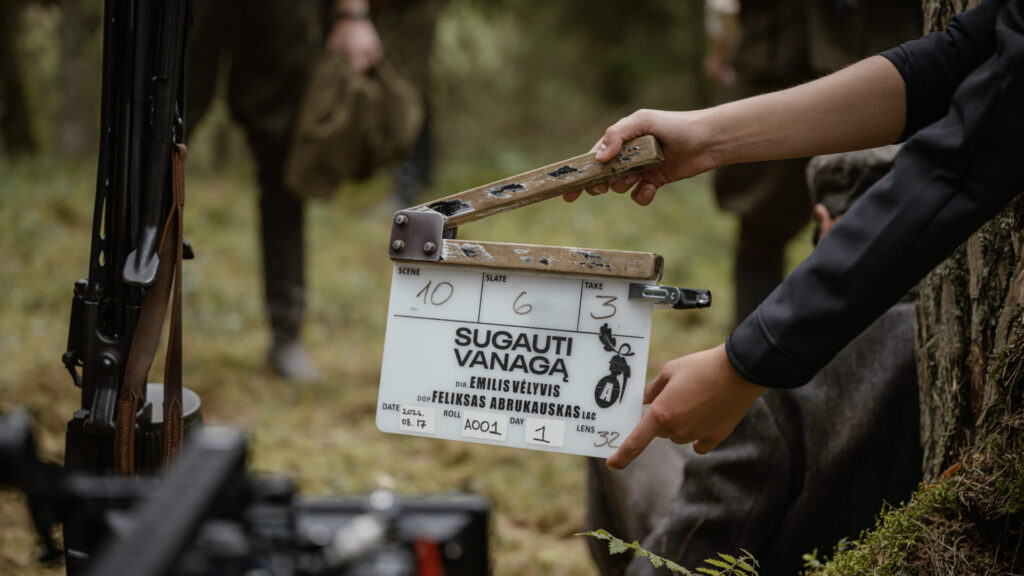
Photos by Lukas Šalna