In cinema, even the smallest detail can have a long story behind it – one the audience may never know. A three-centimetre worm may appear on screen for only a moment, yet take months of experimenting with moulds, resins and colours to create. Laboratory glassware for a science-fiction film may need to be custom-made by glassblowers in Latvia, while something as seemingly ordinary as a blue velvet sofa can suddenly become impossible to find anywhere in Lithuania when a production needs one.
This is everyday life in a film art department. Its work begins long before the actors arrive on set and can sometimes continue for months after the final day of shooting.
Set designer and production designer Emilija Einorytė has worked in various art department roles, from props and set decoration to art direction and production design. Her filmography includes both Lithuanian and major international productions, among them the science-fiction film Vesper and the fourth season of Stranger Things, partly filmed in Lithuania.
Yet when it comes to this profession, the names of high-profile productions tell only a small part of the story. Most of it remains behind the scenes: empty spaces that have to be transformed into convincing worlds, objects that have to be made because they simply do not exist in real life, and weeks of work spent on details that may ultimately disappear entirely in the final edit.
We spoke with Emilija Einorytė about how set design can tell a character’s story without words, why a film artist can no longer casually browse a flea market, and what it takes to create a world convincing enough for the camera to believe in.
– Do you remember the moment you realised you wanted to create worlds specifically for film rather than, for example, theatre? What drew you in?
E. Einorytė: – I do, although it was more of a particular situation than a specific project. I was watching the final performance of one of my favourite theatre productions when I suddenly found myself asking an existential question about its set design: what happens after the scenery ends up in storage or is reused? What remains when the work of art you created no longer physically exists?
You realise that the image you created, and its true weight, remains only in the memory of the person who saw it – and memories eventually fade. The performance had been filmed, but theatre never looks the same on video as it feels when you experience it live.
Perhaps it was a youthful desire for what I created to remain as something almost permanent while retaining the same emotional impact. I would probably see it differently now – there is beauty in impermanence too.
– When you first walk into a completely empty filming space, what do you notice that an ordinary person probably wouldn’t?
E. Einorytė: – The first thing I think about is whether there is enough volume in the space for everything I want to create. Even when I walk into a completely empty studio, I immediately start laying out the set in my head.
Sometimes you think: what’s the big deal, a small house should easily fit in here. But you also have to account for all the equipment around it – lighting rigs, backdrops, clearance space, lifts, tracks and camera rigs.
If it is an existing house, apartment or another interior, I assess how much it will cost to transform it radically into what we need, because ultimately everything comes down to the budget. Even the floor the location is on matters – can the art department crew carry furniture and props in and out? I look at how much light comes through the windows and at the architectural elements. Sometimes simply adding a partial wall can completely transform the architecture of an apartment.
When I see a space in person, I am assessing many different things at once, all of which determine whether it can work for the project at all.
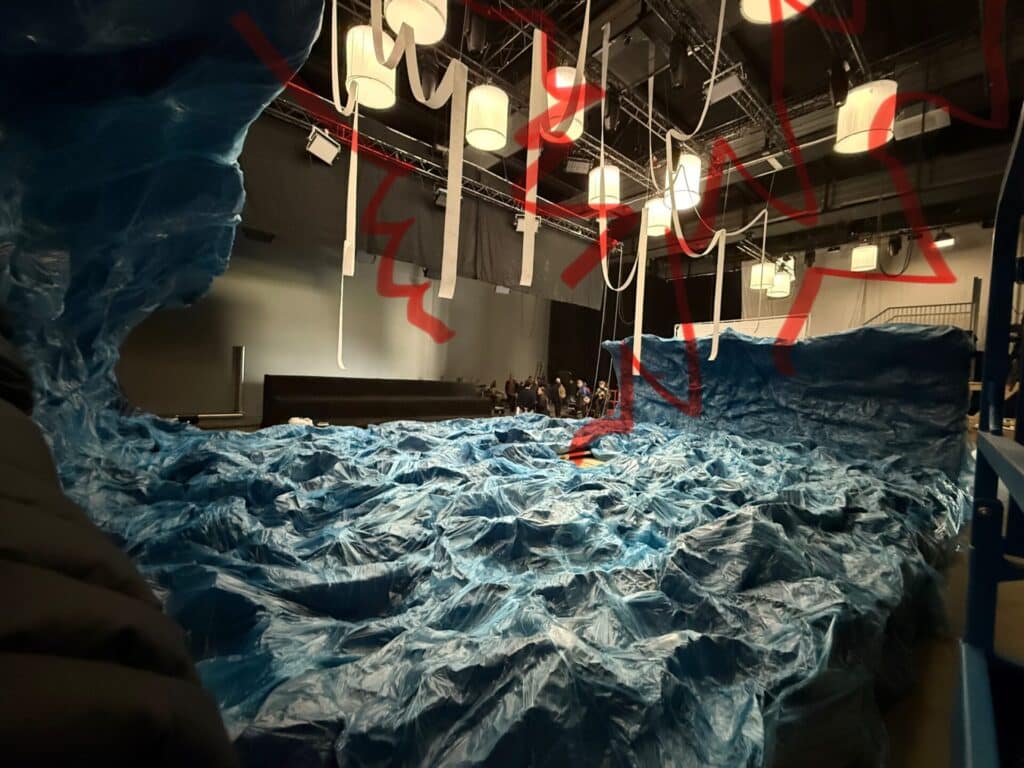
– What is the strangest object you have ever had to find for a shoot? And how far did you have to go for it – literally or figuratively?
E. Einorytė: – Stories like that happen on almost every project. One of the more interesting cases was while working on the Lithuanian co-produced science-fiction film Vesper.
We had to create a laboratory that did not exist and make the laboratory glassware for it. After a long and complicated search, and going through several contacts, we found glassmakers in Latvia who custom-blown the pieces for us.
To many people it might seem simple: it’s only a few minutes on screen, what’s the big deal? Just make it out of plastic. But sometimes, for just a few seconds on screen, we in the art department travel several hundred kilometres.
– How often do you spend weeks searching for or creating a single detail, only for it to appear in the film for three seconds – or not make it into the frame at all?
E. Einorytė: – I would say that is what happens to around 70 per cent of the work my colleagues and I do. During editing, once the material begins to take shape, the director’s vision often changes. On commercial projects, the wishes of the client and agency also play a major role.
Sometimes an entire project gets cancelled even though the footage has already been shot and you have personally spent six months working on it. Then your work simply disappears, and often you are not even allowed to share the visuals.
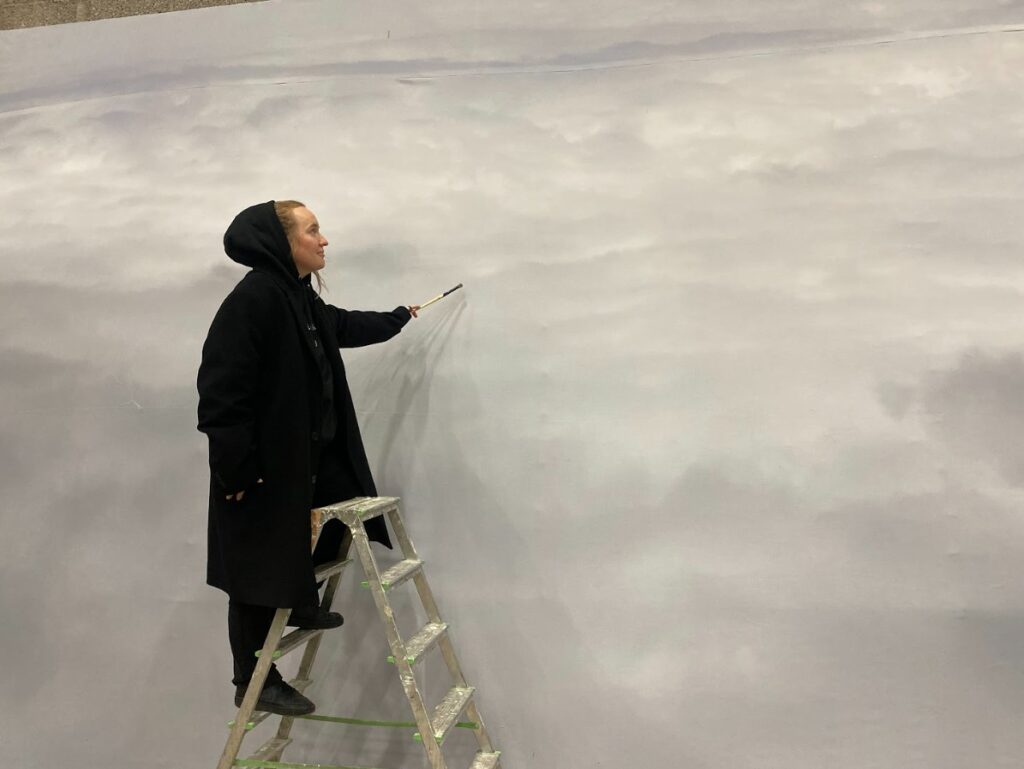
– What is harder: creating an entirely new world, or making a newly created space look as though people have been living in it for twenty years?
E. Einorytė: – To me, the two processes are impossible to compare. Even when you are creating a utopian world, you still have to make it convincing – using ageing techniques and creating depth so that the image does not look flat on camera and the world feels real.
Often the art department assistants arrange objects according to the sketch, and then I spend hours trying to breathe life into the space. The difference is especially obvious on camera: there is static set design, where objects have simply been arranged, and then there is a “lived-in” space that feels real.
That sense of life can come from plants, a half-finished cup of coffee, an apple core or simply carefully constructed mess.
When I create spaces for characters, I talk to the director about who those people are. Perhaps Eglė is a maths teacher who has no luck finding love on dating apps and, having given up on romance novels, decides to take up line dancing. Or perhaps Vasia grew up without his mother’s love and now finds affection while being beaten up by women at Muay Thai group classes who have come there to unleash their inner beast.
A description like that already contains countless details that immediately tell me what their space should look like and how these characters live. No one explicitly explains a person’s entire narrative on screen – often, you understand their story through the space they inhabit.
– After all these years, can you still walk through a flea market or an old apartment simply to browse, or does your mind immediately go: “this would work in a film”?
E. Einorytė: – Definitely not. Usually you are working on one project or another, or you remember a previous one and think: why didn’t I come here six months ago? Or: why has someone only just listed this on Skelbiu?
For one project, we needed a blue velvet two-seater sofa. It sounds like the most ordinary piece of furniture in the world, but naturally, the moment we needed one, there were none anywhere – neither second-hand nor in shops. You search all over Lithuania for that sofa, and then six months later, everywhere you turn, all you see are blue velvet sofas.
That is the fate of an art department person, I suppose.
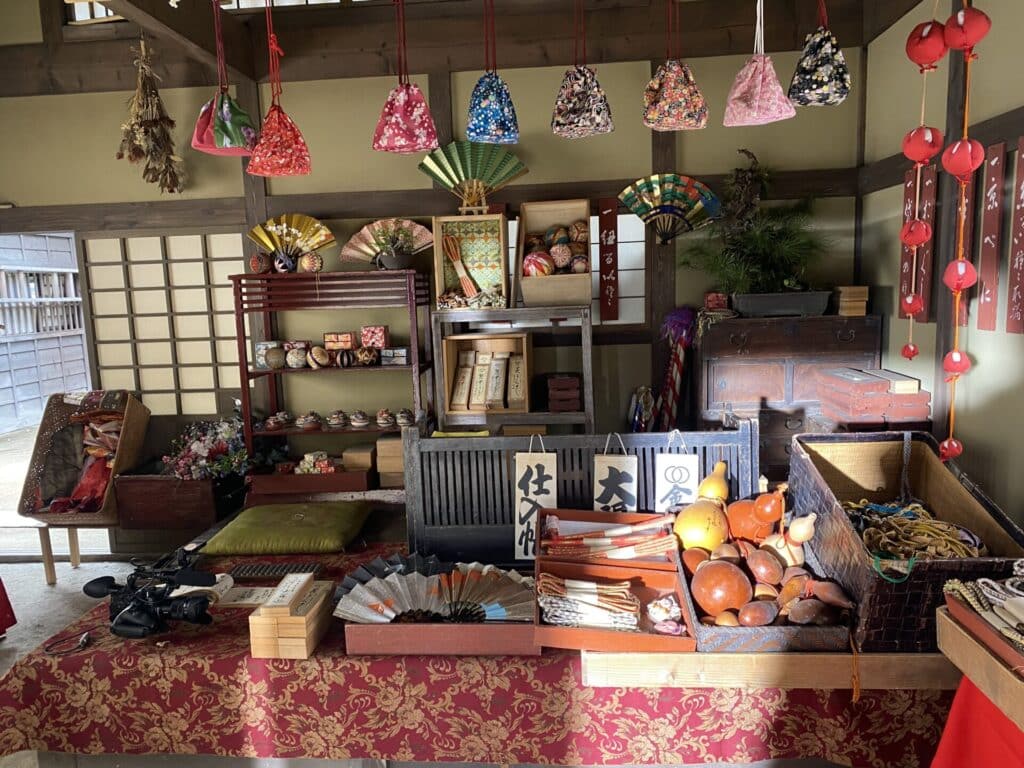
– You have worked in several different art department roles. In which one do you feel you can leave the strongest personal mark?
E. Einorytė: – Without a doubt, when I work as the production designer. At that point, you no longer have to prove yourself to anyone – the people you wanted to work with chose you precisely because they believe in you and your visual language. Then it is up to you to decide whether the project speaks to you or whether its concept feels foreign.
There is something wonderful about creating an imaginary world as an equal partner with a director: discussing it, designing it, living with the idea, sometimes for several years, because you know it is going to work. Then you finally see the result – the realisation of ideas you created together. That is probably the best feeling you can have as a creator, and suddenly all those sleepless nights feel worthwhile.
As an art director, you often execute part of the production designer’s work, provided they trust you, while also managing the entire process – budgets, people, construction and so on. On commercial projects, you often spend more time solving problems than making art.
When I worked as a props designer, the key hero props were in my hands – the objects most prominently featured by the camera and which can sometimes tell you a great deal about a character. When I worked as a set decorator on large films, I was essentially assembling the space piece by piece and spent most of my time making the set feel “lived in”.
In reality, in all of these roles you have to adapt to someone else’s vision – and often more than one. That vision can be creative or simply financial.
Another thing that distinguishes the art department from many other departments is how long it stays with a project. A major production might shoot for 30 days, but the art department can spend more than six months in preparation and then another few months after filming before the project is fully wrapped.
– With Stranger Things, you entered a world whose visual language was already very familiar to audiences. What was the most difficult part of working on the project?
E. Einorytė: – At first, it was difficult to understand how to work because, due to the secrecy surrounding the project, we did not have the full script – only the sections we needed to prepare for filming. But to create a space, you need the full context. A few lines are not enough.
Since it was the fourth season, the visual language was already very clear, so we did not have to spend much time figuring out how to fit into it – we knew what was expected of us.
It is also worth remembering that the second stage of filming took place at the height of the COVID-19 pandemic. We needed special permits, and the crew was divided into separate groups according to their functions, which were not allowed to mix. On top of that, it was around minus 30 degrees outside, and we had to create exterior sets. That was probably the hardest part.
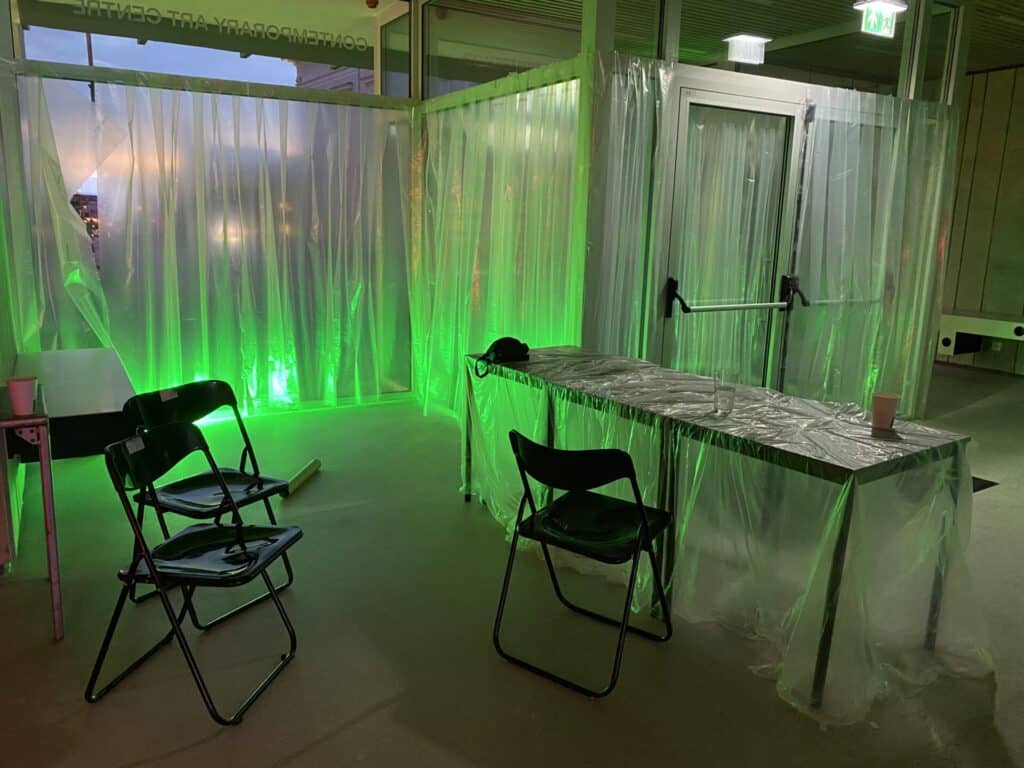
– Vesper required the opposite: creating a world the audience had never seen before. Where do you begin gathering material for a world like that?
E. Einorytė: – I constantly find inspiration wherever I am. I am an active person and enjoy being in very different environments. I photograph textures, shapes, states, spaces and the traces people leave behind in them. I am fascinated by both living and non-living environments.
My phone gallery is often bursting with content because you never know when you might need something. A tangled loop of wires might one day turn into exactly the set piece you need.
With Vesper, I was particularly fascinated by the world of fungi – the colours of mould, for example. Various imitations of those textures and colours eventually found their way onto many of the film’s props.
– The objects in Vesper look as though they had lives of their own long before appearing on screen. How much did you actually have to alter and age them?
E. Einorytė: – In this film, practically nothing was something you could simply buy in a shop and use as it was. Everything was custom-made, aged to at least some degree, or coated in liquid latex.
More than once, we bought up all the latex available in Lithuania and even across Northern Europe, so we had to order more from Germany. We repeatedly made and remade things, searching for new solutions and new forms in order to create things that do not exist in reality.
It was very much a props-driven film – we had to invent the objects, propose them to the director and then bring them to life within a very short timeframe.
The object that probably consumed the most time was a worm. We had to create an artificial, specially patterned worm that, of course, did not exist in real life. It was made using resins and moulds and then painted. You might think: what’s the big deal? It’s only three centimetres long. Yet several different makers spent months trying to get it right.
– If you had to choose one set, space or even a small object from your entire career and say, “this is very me”, what would it be?
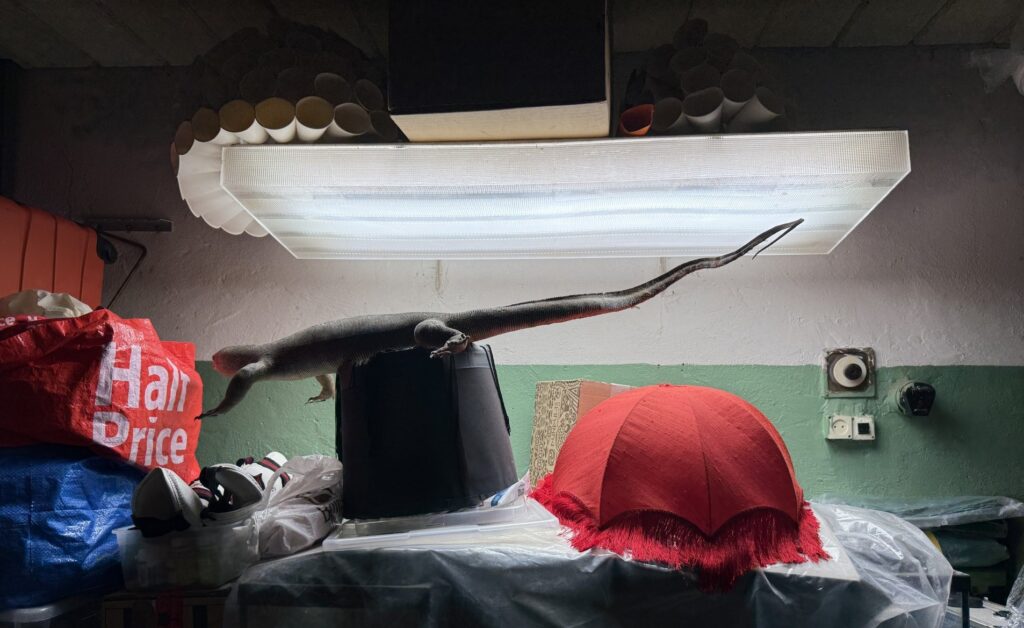
E. Einorytė: – For Jurgis Matulevičius’ film China Sea, we created a cigar room that ultimately did not make it into the final cut. The centrepiece of the room was a stuffed monitor lizard.
I remember driving to an antiques market in Merkinė looking for props, seeing that monitor lizard and thinking that nothing could describe those people better than this animal.
So I would probably choose this prop that never got its moment of cinematic glory – and the reasoning behind why I chose it for the film – as the thing that best represents me.
– Thank you for the conversation!
Photos from Emilija’s personal archive