Vilnius Film Office presents the documentary series “Films That Changed the History of Lithuanian Cinema”. Through conversations with directors, actors and those who witnessed the industry’s evolution first-hand, the series explores not only key moments from the past, but also the growth and maturation of Lithuania’s film industry over 35 years of independence – the films that became turning points and those that built bridges to the wider world. Major awards, Lithuania’s first international projects, bold themes, unexpected turns and the determination to speak in a different cinematic language – this is the story of a cinema that grew alongside Lithuania.
Released in 2022, Kristina Buožytė and Bruno Samper’s “Vesper” marked a step into territory that Lithuanian cinema had barely explored before. A Lithuanian-French-Belgian co-production, the film takes audiences into a bleak future in which humanity struggles with food shortages and survival on a devastated Earth. In this world, thirteen-year-old Vesper cares for her seriously ill father and conducts biological experiments, hoping to find a way to change not only her own future, but that of others as well.
Producer Daiva Varnaitė-Jovaišienė recalls that when director Kristina Buožytė began looking for a team willing to take on a project of this scale, the challenge itself became one of the reasons to get involved. Lithuania had very little tradition of science-fiction filmmaking – one of the few previous examples of the genre was Buožytė’s own “Vanishing Waves”. For the filmmakers, therefore, the project was about more than making a single film: it was also an opportunity to expand the boundaries of genre cinema in Lithuania.
The world of “Vesper” was conceived as a future in which conventional technological infrastructure has collapsed, while genetic engineering has advanced dramatically. This meant the filmmakers could not simply rely on contemporary environments and objects. The entire world had to be imagined and built from the ground up in a way that audiences would believe.
One of the key concepts behind the film was “organic”. As director Kristina Buožytė recalls, the word kept coming up in conversations with the art department, actors and cinematographer. The future was not supposed to look sterile or digital. Even light was imagined as something alive – an organism that needed to be cared for and replenished. Futuristic elements were meant to grow out of nature rather than replace it.
This idea was also central to cinematographer Feliksas Abrukauskas’ visual approach. When searching for locations, the team looked for landscapes that would feel familiar while simultaneously evoking a lost world. Filming took place in spring, before the trees had grown their leaves – in the film’s world, much of nature has died, with only traces of genetic experimentation remaining. Old forests, fallen trees, valleys and unusual landscapes helped create a vision of the future not by transporting the audience to an entirely alien planet, but by transforming a world they could recognise.
For Abrukauskas, one of the greatest challenges was not to cross the line where this future would begin to feel too distant. The film’s imagery had to make audiences believe that this world was not hundreds of years away or somewhere on another planet – it could begin just outside our own front door.
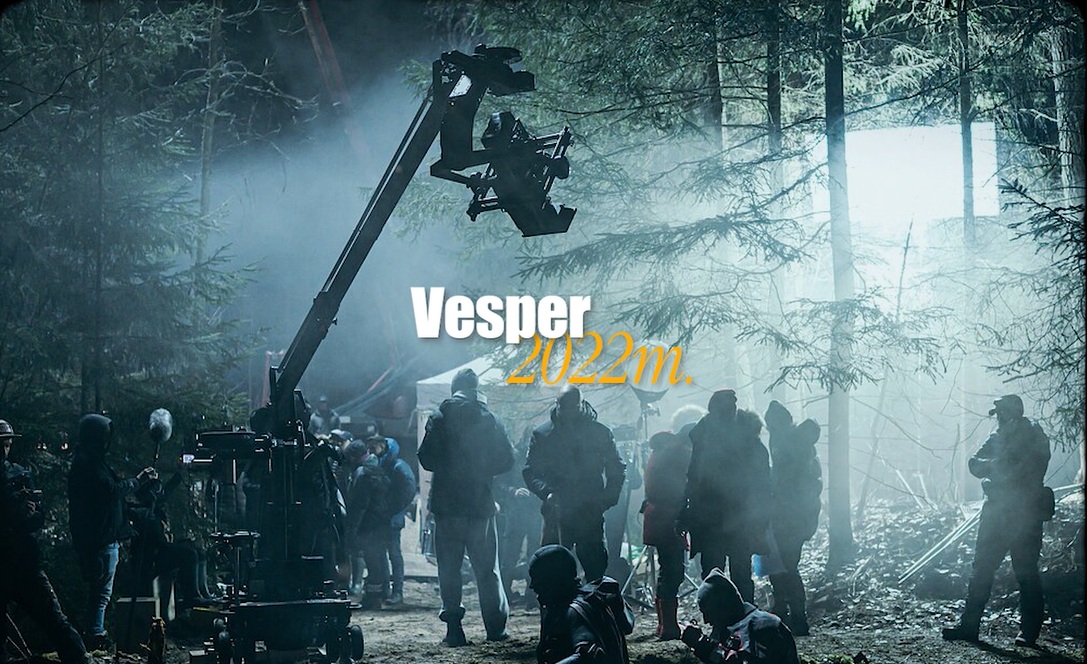
Equally important was the physical construction of the world of “Vesper”. The production design sought to emphasise materiality, texture and the physical weight of objects. Nothing in this world could look new – every object was created as though it had already lived a life and carried a history of its own. Sets were built beyond what the camera would actually capture, allowing the actors to move through them, touch objects and inhabit the world rather than imagine it in front of a green screen.
Production also coincided with the COVID-19 pandemic. Unexpectedly, the isolation reinforced the filmmakers’ ambition to immerse the actors in the world of the film – after arriving in Lithuania, they lived almost entirely within the project. According to the filmmakers, when the actors first entered the constructed environments, they could explore, touch and discover them for themselves, helping turn the world of “Vesper” from a set into a tangible environment inhabited by their characters.
The film also became a major challenge for Lithuanian film professionals. According to Abrukauskas, the majority of the production crew were Lithuanian, while the international team was primarily involved in post-production, visual effects and acting. For an industry where science-fiction films of this scale are rare, “Vesper” offered an opportunity to test its capabilities in building a futuristic world and tackling unusual technological and creative challenges.
“Vesper” had its world premiere in the main competition of the Karlovy Vary International Film Festival. The film later received further international recognition, including the Jury’s Choice Award at the Bucheon International Fantastic Film Festival. According to Varnaitė-Jovaišienė, “Vesper” became an intriguing hybrid of auteur and commercial cinema, capable of reaching very different audiences.
At the same time, the film raised another important question for Lithuanian cinema: what defines a national cinematic identity today? “Vesper” was shot in English and made with international partners and actors, yet, according to the producer, this did not mean losing its Lithuanian identity. The film demonstrated that the language in which a film is made does not necessarily determine its national identity.
Can “Vesper” be described as a turning point in the history of Lithuanian cinema? Its creators approach the label with caution – a single film cannot transform an entire industry. Yet Lithuania had never before undertaken a project of this complexity, requiring such a combination of creative, technological and production solutions.
“Vesper” expanded the boundaries of what could be created in Lithuania. It demonstrated that Lithuanian film professionals can do more than contribute to international science-fiction productions – they can build these worlds themselves, from the first object placed in front of the camera to an entire vision of the future.