Director Andrius Lekavičius’ documentary Chasing Gold in the Dark was originally intended to follow the Lithuanian men’s goalball team on their journey to the Paris Paralympic Games and their fight for medals. But in documentary filmmaking, stories rarely follow a script written in advance. When the team failed to qualify for the Paralympic Games and some of its members ended their professional sporting careers, the film’s focus shifted from results on the court to life beyond it.
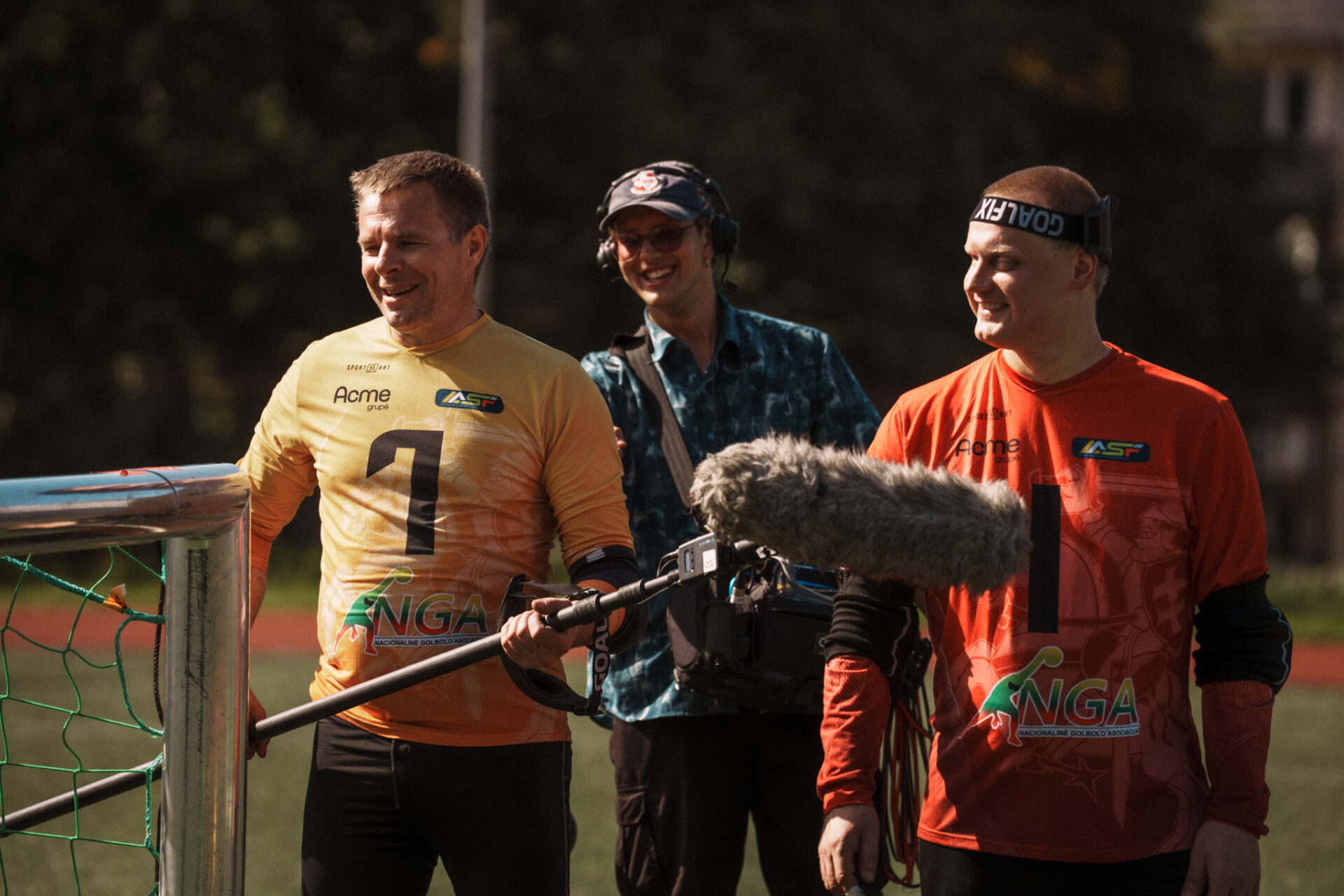
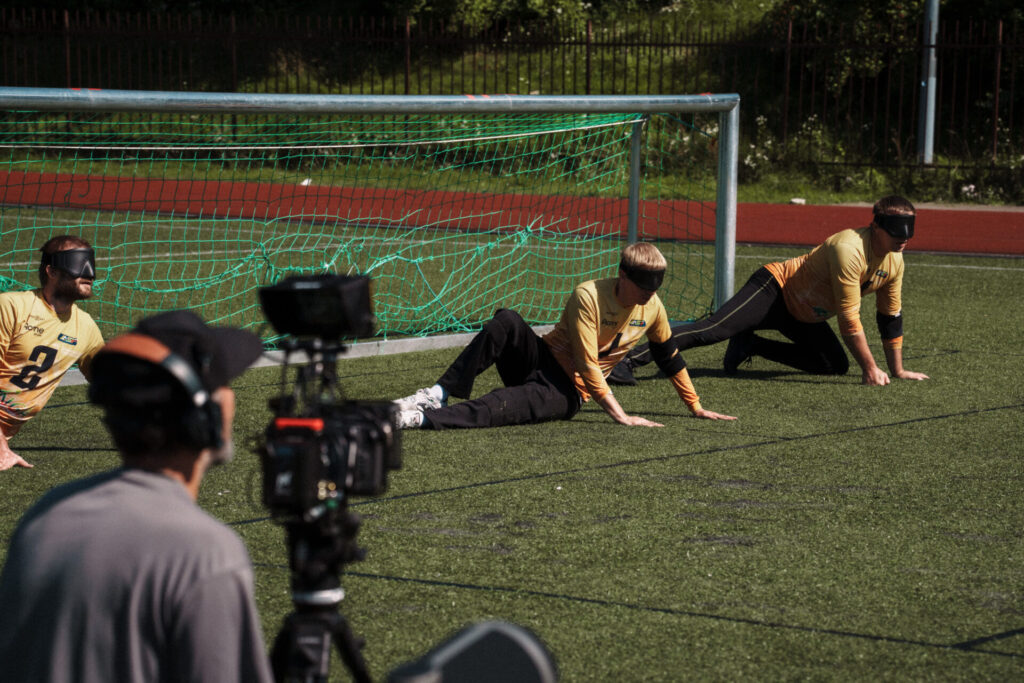
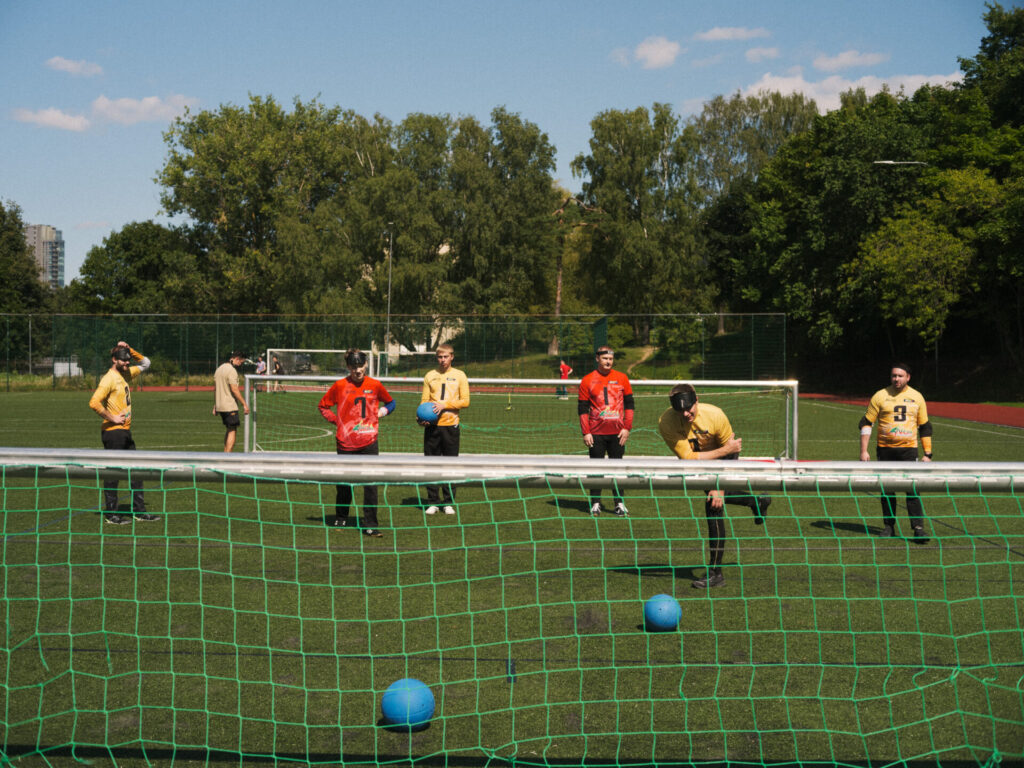
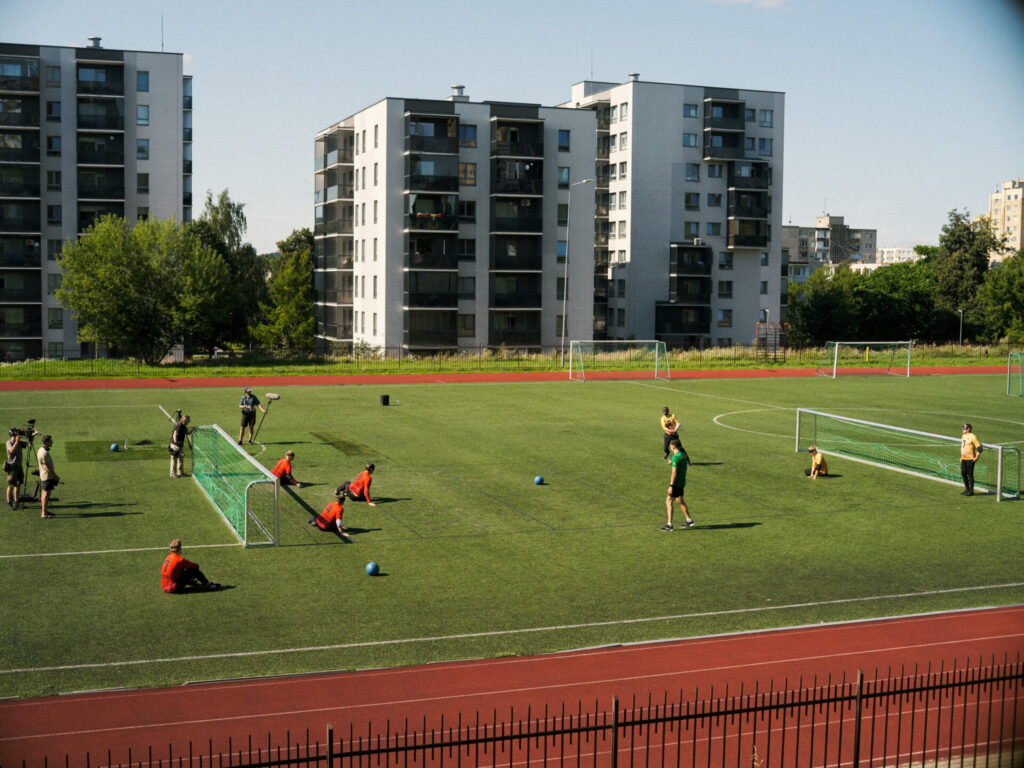
This summer, one of the most unusual episodes of the upcoming film was shot in Vilnius: for the first time, the Lithuanian goalball team played outdoors specifically for the cameras. At the Gerosios Vilties Stadium, the familiar silence of an indoor sports hall, its walls and predictable acoustics were replaced by the hum of the city, the wind and an open space. For the director, the experiment became not only an opportunity to search for a new visual language for the film, but also a metaphor of sorts for the athletes’ current stage in life – leaving behind the familiar environment of professional sport and stepping into a world where they must find their place anew.
We spoke to director Andrius Lekavičius about a story that evolved from a sports film into a human portrait, the challenge of “translating” the world of blind people for sighted audiences through cinema, playing goalball under the open Vilnius sky, and the boundary between a documentary filmmaker and his subjects.
– You have been working on Chasing Gold in the Dark for several years now. How similar is the film today to the one you imagined when you first turned the camera towards the Lithuanian goalball team? What has changed its original direction the most?
A. Lekavičius: At the beginning, I had a very clear timeframe – the Paralympic cycle. The Lithuanian team’s journey towards the Paris Paralympics, ending with them winning Paralympic medals. That was the ideal original scenario. But documentary filmmaking is an unpredictable process: the initial idea changes and takes you somewhere else. On their way to the Paralympics, the Lithuanian team stumbled at the final hurdle – they lost the European Championship final and, for the first time this millennium, failed to qualify for the Paralympic Games. That defeat significantly changed the original idea, but it also opened the door to a deeper story.
While filming, I also realised that a visually impaired athlete spends two hours a day on sport, while the challenges they face throughout the rest of the day are often even greater than those they encounter in sport. The film gradually became more of a social portrait of professional athletes with disabilities. At the same time, some members of the national team ended their sporting careers, which ultimately shifted the film’s focus away from sport and towards the individual. Paradoxically, although the film today is completely different from what I originally envisioned, it is much closer to what drew me to the story in the first place.
– This summer, the Lithuanian goalball team played outdoors for the first time, specifically for the film. Where did the idea of taking goalball out of its usual indoor environment come from, and why did you choose the Gerosios Vilties Stadium in Vilnius?
A. Lekavičius: Goalball is the only Paralympic sport that was not adapted from a sport for able-bodied athletes, but was created specifically for people with visual impairments. And goalball exists in a kind of vacuum. The sports hall, the silence, the walls that reflect sound – together, they form a map of the players’ world. I was interested in seeing what happens when you open up that vacuum. It is an experiment that fits the film’s new vision: the end of a career is also about leaving the sports hall, where you know everything, and stepping into an open space filled with more background noise.
At the same time, it was a cinematic experiment. Together with cinematographer Adomas Jablonskis, we are still searching for the right visual language for the film, experimenting with different cameras and movements. We want to show goalball in an unusual and engaging way. We filmed the outdoor game using cameras without infrared-cut filters, which makes the colours appear different from conventional footage. Gerosios Vilties Stadium also worked well logistically – it is next to Gerosios Vilties Progymnasium, where the goalball players train, and in the afternoon the stadium gets beautiful sunlight.
– For goalball players, sound on the court serves the role that sight plays in other sports. What happens to the game when there are no sports hall walls or familiar acoustics, and instead there are city sounds, wind and a large open space?
A. Lekavičius: Since I wasn’t playing myself and was only observing from the sidelines, what I can say is that there were significantly more goals than usual. After the game, the players all kept saying the same thing: “Strange.” And this is exactly where their phenomenal ability to adapt becomes apparent – something that has fascinated me since the very first day of filming. They may be slightly disoriented for the first few minutes, but then they begin to “read” the space and make it their own: they tune out the hum of the city and focus on the sounds on the grass.
I realised a simple truth: the world of blind people is built from reflections. Take away the walls, and they rebuild it from whatever remains.
– Cinema is fundamentally a visual medium, yet you are making a film about people whose relationship with the world is not primarily visual. Has making this film forced you to rethink what images can actually communicate in cinema – and what they cannot?
A. Lekavičius: It has, and that process of rethinking has become the driving force of the film. From the very beginning, we have kept returning to one question: how do you film something that cannot be seen? Cinema is a visual medium, while the world of my protagonists is one of sensations, sounds and touch. An image can show the surface: a body, a fall, a scar. But it cannot show darkness from the inside. So in this film, the image stops being all-powerful and becomes a translator.
On the goalball court, we use a static camera and slow-motion shots in which the players’ falls and throws become a kind of ballet: the image reveals something the naked eye would otherwise miss. In everyday life, we use a “breathing” camera that conveys the chaos of an environment you cannot see. And where the image ends, sound begins – it will guide the audience through the film in the same way that it guides my protagonists through life.
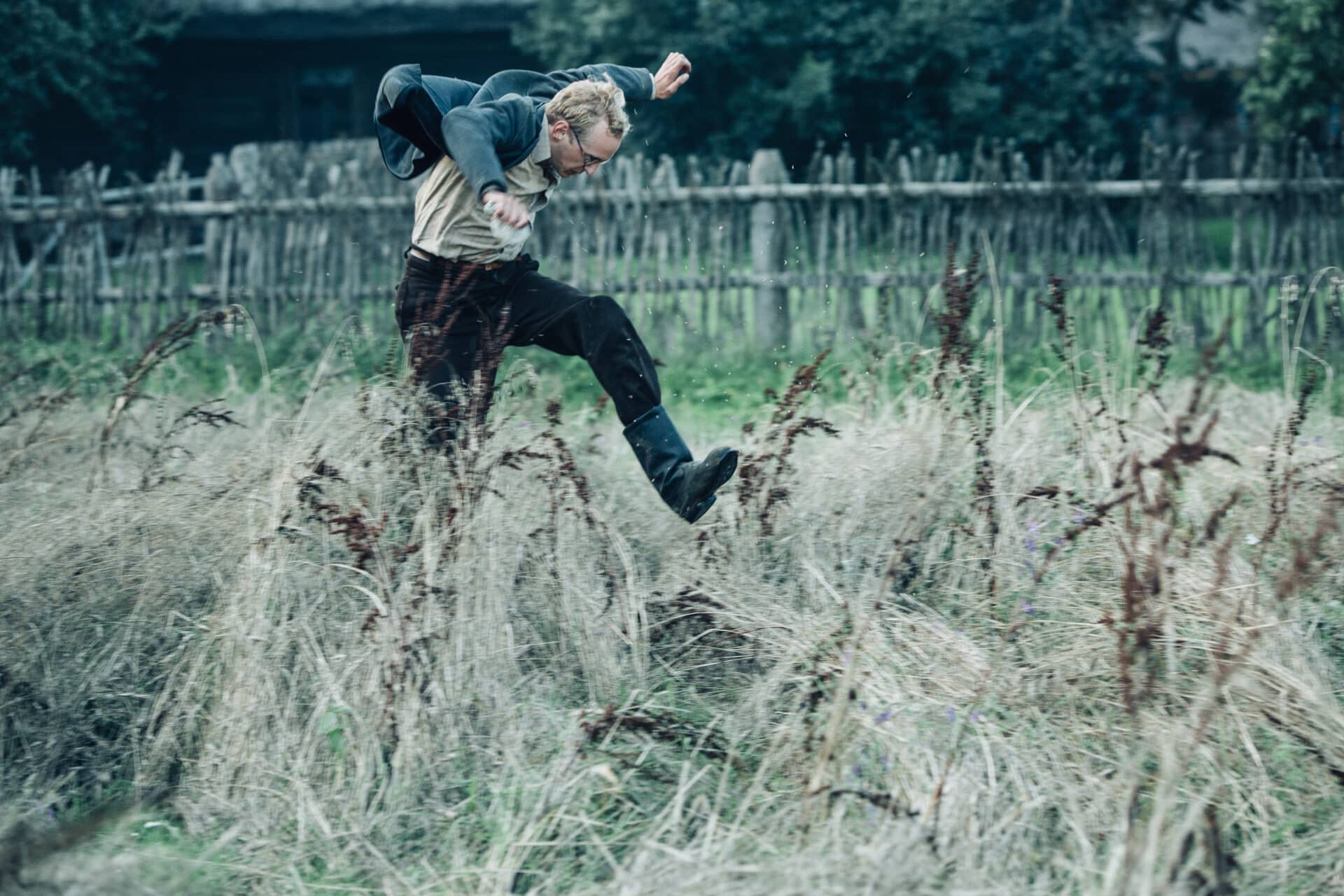
– In the film’s black-and-white stills, familiar Vilnius locations become almost unrecognisable. What role will this visual language play in the film? Are you trying to bring the audience closer to the way your protagonists experience their surroundings, or are you deliberately avoiding an attempt to imitate the experience of blindness?
A. Lekavičius: I don’t want to imitate the experience of a blind person, because even a successful imitation would still be just that – an imitation. I cannot “give blindness” to a sighted viewer by switching off the image or turning the screen into a black rectangle. Blindness is not a switched-off screen; it is a world that functions differently.
For me, the black-and-white, defamiliarised image of Vilnius is not an imitation, but a translation. When you remove familiar colours from a familiar space, the viewer briefly loses their sense of certainty – they no longer quite know where they stand and have to rely on something else: intuition, sound, rhythm. That brief sense of disorientation in a familiar place is as close as we can honestly bring a sighted person to the everyday experience of the film’s protagonists.
I don’t want to show what they see – because the answer would be “nothing” – but rather what the world feels like when you piece it together through sound and memory.
– You have said that the goalball players were quite comfortable with the camera from the very beginning, even allowing you into the changing room. But the camera has now been around them for several years. How has your relationship changed over that time, and was there a moment when you realised they had completely stopped behaving like “film subjects” in front of the camera?
A. Lekavičius: I was surprised myself by how readily they let us in. I have filmed the Lithuanian national basketball team before, so I know how strongly cameras and outsiders are avoided in the changing room. Here, from the very beginning, we were like flies on the wall.
But the most interesting thing is that the foundation of our relationship is not visual – they cannot see the camera. They hear me and cinematographer Adomas: our footsteps, our breathing, our voices, the way we move through the space. There were several turning points. The first came when the team’s banter stopped flying past us and started being aimed at us. When you become the target of the jokes, you know you’re one of them. I also had to get used to the remarks about the film’s constantly rewritten script.
– In sports documentaries, it is very easy to build a story around the classic formula: training, an obstacle, a major competition, victory or defeat. Your protagonists’ lives seem to extend far beyond the scoreboard. How do you avoid fitting them into a convenient narrative about people “overcoming disability”?
A. Lekavičius: The simplest answer is that this film only reaches its halfway point where most sports films would normally end. We are trying to show the transition that happens when professional blind athletes end their careers and what their lives look like afterwards. The film’s protagonists are not symbols. They are people with brilliant, sharp senses of humour, with weaknesses, with pain, with wives and children without whom they would not even make it to training.
I hope the film will challenge audiences to reconsider the limits of ability and the familiar lines society draws between people with disabilities and those without them. The film seeks to erase these invisible lines by introducing people who, through what they do every day, continually redefine the boundaries of human possibility.
– You mentioned that without the support of the Vilnius Film Fund, this outdoor shoot probably would not have happened. What did that support allow you to do creatively? Is there a particular shot, scene or idea that simply would not exist in the film without it?
A. Lekavičius: Very specifically: goalball outdoors, in the stadium. That scene simply would not exist without this support. An experiment like this is not a matter of simply “showing up and filming”. The court, goals and lines all have to be prepared so that the game can take place safely.
– Thank you for the conversation!
Photos by Martynas Norvaišas