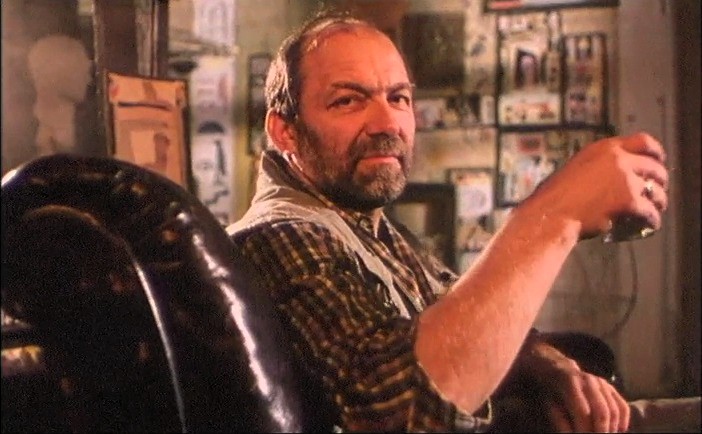
Very soon, Lithuanian cinema screens will welcome the new film Sand in Your Hair by director Mantas Verbiejus, starring actors Jūratė Onaitytė and Liubomiras Laucevičius in the leading roles. Sand in Your Hair tells the story of older people who decide to embrace change and free themselves from loneliness. Actor Liubomiras Laucevičius speaks to the Vilnius Film Office about his filming experience, the moments that matter most to him as an actor, and the upcoming film.
– Liubomiras, what attracted you to the screenplay of Sand in Your Hair? What was the spark that made you decide to play the role of Kipras?
I remember the film’s director, Mantas Verbiejus, coming to Kaunas to meet me – we walked along Laisvės Avenue together, and later I received the script. I found the story itself intriguing: an elderly woman who decides to radically change her life without knowing where she is going or who she will meet there. I was also drawn to the fact that the film focuses on an age group rarely seen in cinema. As for Kipras, he is not only an artist who sees the world differently, but also a man suffering from illness. Creating such a character was genuinely interesting.
– How much do you have in common with Kipras? What was the most challenging part of creating this character?
I had never played a role like this before. Kipras is a loving person who, due to sudden and difficult-to-control seizures, is unable to take care of himself. This meant I had to take the nuances of illness into account. Age gives a lot to every role – the more roles you’ve played, the more educated and experienced you become, the harder it actually gets, because you notice more details that demand attention.
– How did the collaboration with the director and the creative team go? Were there moments that helped you see the creative process differently?
The creative team was very focused and calm, clearly knowing what they were doing. Mutual understanding is essential – when both the creative and technical teams truly sense one another. I often perform in theatre productions with my film partner Jūratė Onaitytė, so it was easy for us to find common ground here as well. We were also fortunate with the weather – the summer of 2024 was exceptionally warm.


– How does acting in film differ from theatre?
In film, nothing happens in sequence or according to the script’s order. Sometimes filming begins with the ending, so you don’t yet know what your relationship with other characters will be or how the story will develop. Then there are long breaks between shoots – for example, when you have to wait for spring or winter. Theatre is completely different – the curtain rises, and the action unfolds continuously.
– Do you go to the cinema often? What kind of films do you enjoy?
I’ll admit that lately I don’t go to the cinema very often. I’m not a big fan of action films – when watching them, I don’t always understand the characters’ inner lives or their reactions to events. I miss a deeper perspective. I enjoy well-written roles, which more often appear in film adaptations of literary works. Original screenplays are rarely strong, so I’m glad that Sand in Your Hair is a pleasant exception.
That said, young Lithuanian directors often draw inspiration from abroad – sometimes I feel there is a tendency to imitate international practices. We should look for our own angle, our own ideas, and discover our own voice.
– What feelings or thoughts would you like viewers to take away from this film?
I’ve only seen the film once so far – I will definitely watch it again. The first time, I focused more on the editing: which scenes were included, which were rearranged, what remained and what didn’t, how other characters and I myself appeared on screen, and whether our relationship felt truthful.
For me, this film is full of optimism and faith – faith that people can fall in love, connect, and open up to one another even later in life, without giving in to isolation. We can change ourselves at any time – even at an older age.
– What would you wish or advise young actors who are just stepping onto a film set?
It is always difficult for young actors, because many things are beyond their control. Often, appearance, temperament, and type are evaluated – sometimes you simply have to “fit” the role. For some, success comes quickly; others need time to mature and wait for their moment. Still, if a person truly wants to achieve results, hard work is essential – not only delving into the role itself, but also engaging with literature, visual art, and music, which help shape a deeper worldview and character understanding. Only then can you discover qualities that are personal, unique, and impossible for anyone else to replicate.
– After so many years in theatre and film, what has this profession given you?
I chose the path of acting; others became teachers, doctors, engineers – there are many wonderful professions that bring hope and light. From an early age, I wanted to become an actor, and I succeeded, so it is natural that I consider this profession meaningful. If you are passionate about what you do, strive to perform your tasks well, and pursue your goals, then your work always has meaning. As for success – you can never fully predict it, because so much in life depends on circumstances.